Catch Me If You Can,
Auto Focus,
Far From Heaven and
the Art of Retro Title Sequences by Deborah Allison
Source: sensesofcinema.com
Deborah Allison is based in the UK and has recently completed a PhD at the University of East Anglia: “Promises in the Dark: Opening Title Sequences in American Feature Films of the Sound Period.”
A title sequence is more than just a list of credits. It can be a mini-movie which sets up the film that it’s a part of. It can establish mood, period and style. A title sequence can take care of backstory. It can soothe the audience or get them agitated. Title sequences are an art form of their own.
– Big Film Design (1)Over the past few months we have been treated to a wave of American films that have taken as their source material the film styles and genres of times gone by. Films such as Catch Me If You Can (Steven Spielberg, 2002), Far From Heaven (Todd Haynes, 2002), Chicago (Rob Marshall, 2002), Undercover Brother (Malcolm D. Lee, 2002) and Auto Focus (Paul Schrader, 2002) have shared the agenda of lavishly recreating period features whilst positioning themselves explicitly within earlier cinematic traditions. Several of these films, including Catch Me If You Can, Auto Focus and Far From Heaven, have announced their intentions from the very beginning, signalling their relationship to their antecedents by using title sequences that combine highly evocative images and musical scores. It is these films I will discuss in this article.
Each of these movies is located at a very specific point in time and space. Each is also characterised by its generic revisionism. Far From Heaven recreates the closeted suburban affluence of Eisenhower’s America in 1957. In doing so it pays homage to classical Hollywood melodrama and in particular the films of director Douglas Sirk, whose 1955 movie All That Heaven Allows forms its explicit basis. Catch Me If You Can showcases the jet-setting new prosperity of the mid-late 1960s, at the same time revisiting the caper movie so popular at that time. Auto Focus charts a course from the clean-cut home entertainment industry of 1964 Los Angeles to the deterioration of family values and the rise of home porn in late 1960s and 1970s America, its focus on actor Bob Crane (Greg Kinnear) resurrecting the tradition of the celebrity biopic. In each film, the set and costume designs painstakingly emulate the fashions and decor of their respective eras. Nevertheless, they all derive their verisimilitude less from a bid for historical authenticity than from the cinematic heritage on which they draw.
All three films use their opening title sequence to signal from the outset the sensibility that defines them. To do so is a pervasive technique, as the above quotation from Big Film Design indicates. It has been widely used for decades, and is not in itself peculiar to revisionist movies. Examples range from the animated title sequence of Move Over Darling (Michael Gordon, 1963), which sets a sprightly tone and summarises the entire narrative through the witty orchestration of three wedding rings, to the ‘creepy’ lettering, oozing in front of a misty backdrop in Voodoo Woman (Edward L. Cahn, 1956), or the scratchy hand-lettering of Berlin Horse (Malcolm Le Grice, 1970). There, as David James has argued of many other avant-garde films, “authorship is inscribed not in the narrative or the imagery so much as in the self-consciously domestic manufacture.” (2)
Catch Me If You Can has been compared to “the light, sophisticated Cary Grant comedies of the 1950s and 1960s.” (3) The tale of teenage con artist Frank Abagnale Jr (Leonardo DiCaprio), ever metamorphosing his identity in the course of his relentless pursuit by an FBI agent Carl Hanratty (Tom Hanks), it opens with a title sequence that combines the chase motif with an aura of playfulness and excitement. Designed by Olivier Kuntzel and Florence Deygas for Nexus Productions, the sequence is a brightly coloured animation of geometrically stylised figures chasing one another through geometrically stylised scenery.
The sequence moves through a series of locations, from airport, to road, then poolside bar, a hospital, a library and a wedding party, the colour scheme changing with each new setting. Little yellow arrows point to the silhouetted figures representing Frank and Hanratty, so that their progress can be tracked as the Frank figure subtly shifts identity from aeroplane pilot to doctor and so forth. The figure of Hanratty gets ever closer as the sequence unfolds, until they finally share a frame during the producer credit. A fade out leaves the end of the tale open, upholding the suspense of the main film. Other whimsical pleasures are interspersed throughout the sequence, such as the jokey conjunction of technical credits with iconic items. For instance, the real Frank W. Abagnale, author of the book from which the film derives, is credited during the library sequence, and musician John Williams’ credit is placed next to the image of a grand piano.
These titles have been widely noted by reviewers, who have likened them to Depatie-Freleng’s celebrated animations for the Pink Panther films as well as more general design trends of 1960s titling such as the work of Saul Bass. (4) Comparisons might also be drawn with the Disney family comedy, Emil and the Detectives (Peter Tewksbury, 1964), with its three angular ‘Skrinks,’ faceless, black hatted and suited in front of a navy background. The technique of annexing technical credits to appropriate images has been used in a horde of earlier films. Fittingly, this ruse was especially prevalent during the 1950s and 1960s, where it can be found in such movies as Houseboat (Melville Shavelson, 1958), To Kill a Mockingbird (Robert Mulligan, 1962) and Do Not Disturb (Ralph Levy, 1965).
![]() |
| The Pink Panther |
Sight and Sound magazine went so far as to describe the title sequence of Catch Me If You Can‘s as one of the film’s two most striking features. (5) Such acclaim in itself recalls that which greeted The Pink Panther credits. Whilst Bosley Crowther’s New York Times review of that earlier film was not altogether complimentary, he added,
There is one thing about this picture that is clever and joyous at least. That is a cartooned pink panther that runs through the main titles at the start, making mischief with the lettering, insistently getting in the way. He is so blithe and bumptious, so sweet and entirely lovable that he’s awfully hard to follow. It’s questionable whether the picture does. (6) Indeed, such was the panther’s success that he starred in his own long-running cartoon series on television, spawning an ever-popular merchandising franchise. There is certainly no accident in the fact that Catch Me If You Can‘s title sequence, like the rest of the film, makes unmistakable its relation to its forebears. Co-designer Olivier Kuntzel comes from a family with a strong design background and is brother to the French film academic and videomaker, Thierry Kuntzel, who authored a detailed and insightful analysis of the opening title sequence of The Most Dangerous Game (Ernest B. Schoedsack & Irving Pichel, 1932). (7)
The wide critical acclaim that has greeted the titles of Catch Me If You Can is founded on several factors. Firstly, their style combines a startling modernity with a retro cool that powerfully recalls the light comedies of the 1960s. Its resemblance to The Pink Panther titles, achieved through the combination of visual imagery and a Henry Mancini-like score, offers a well-known point of reference that invokes the sprightly crime films so characteristic of that era. Secondly, it sets the tone perfectly for the tale that follows: a tale where pleasures arise no more from the story itself than from the telling of it. “Like Frank himself, Catch Me If You Can is restless and playful, forever trying out new styles,” argues Geoffrey McNab. (8) The title sequence is just the first of these. Last but not least, to watch the title sequence is a pleasurable experience in its own right. It may indeed prepare the audience for the main narrative but at the same time it provides an almost entirely separate work that contributes, like trailers and advertisements, to the diversity of the programme.
Auto Focus is a very different kind of film from Catch Me If You Can. It charts the personal and career trajectory of Hogan’s Heroes star Bob Crane from wholesome family entertainment icon and devoted husband to a compulsive philanderer whose autoerotic obsession with home-porn spirals out of control and in doing so destroys his career, family life and personal relationships. The film, especially in its early parts, faithfully emulates the aesthetics of ’60s film and television family entertainment, only later deviating from this style in order to represent the decay of that milieu’s associated values. The title sequence, designed by Ken Ferris, acts as a point of connection between these parts: light in style and mood, but using motifs that anticipate Crane’s personal free-fall. The causes and means of his degeneration are thus present as latent images from the very beginning.
The title sequence’s visuals mark both the period in which the film was set and the ironic distance the film upholds between that era and its point of production. In doing so, they evince an almost clinical detachment from the subject of the film. “For all its dedication to showing Bob’s excesses and misapprehensions,” argues Cynthia Fuchs,
the film opens with credits, under Angelo Badalamenti’s slick-jazzy score, that posit a peculiar distance from its subject. Martini glasses, bikinis and cigarette holders, Hugh Hefner and Polaroid cameras: the images designate an era, a place, a sense of insularity, ease, and privilege. And so: L.A, mythic land of pretty surfaces and preening affects. (9) By establishing this cultural context from the start, the film is able to pithily convey its take on the main characters. It is their “absolute inability to see themselves,” argues Fuchs, that “most clearly indicts Bob and John (Willem Dafoe). Not as perverts per se, but as products of a culture premised on consumption and illusion, endless need and promise.” (10) Nothing could signal this meaning more effectively than the title sequence that launches the film.
Like Catch Me If You Can, this sequence also exhibits debts to titling styles of the era depicted. It simply screams early 1960s, using a carefully choreographed array of silhouetted designs that move fluidly across the screen, overlapping with one another so as to provide a formal pleasure of semi-abstract animation, redolent of the animated jigsaw pieces that open The Misfits (John Huston, 1961). In the choice of shapes used, it further recalls Rock All Night (Roger Corman, 1957), whilst the sectioning of the screen into areas of pastel colour echoes Portrait in Black (Michael Gordon, 1960). As in Catch Me If You Can, and many title sequences of the late 1950s and 1960s (the first decade of widescreen cinema) the frame is emphatically a two-dimensional space, to be geometrically divided up and sectioned off, a flat canvas that attempts no illusion of scenic depth.
![]() |
| Atomic Cocktails |
None of the title sequences of that period used a montage of contemporary artefacts in such a schematic way as Auto Focus, however. The first film to do so was probably designer Don Record’s arresting collage of pop art and psychedelia in How Sweet It Is (Jerry Paris, 1968). The titling of Auto Focus certainly finds its stylistic inspiration in contemporary artefacts but the way they are used is a product of the post-modern era, bearing closer relation to such recent montages as those adorning the 1998 book, Atomic Cocktails. This beautifully produced recipe book illustrates in every detail its argument that “the cocktail came to represent the unique American talent for combining disparate components into a final suitable product for mass consumption.” (11) The sequence can itself be seen as a cocktail in which commingled elements convincingly delineate both the milieu of the film and the complex interchange of agents that help determine the path of Crane’s life. Just as the masterful plot summary achieved in the opening titles for Catch Me If You Can are most fully appreciated after viewing the whole film, so the credits for Auto Focus have an added resonance on a second viewing when the implications of the montage elements are fully recognised.
Designed by Bureau, who had previously worked with director Todd Haynes to design the titles for his earlier films, Safe (1995) and Velvet Goldmine (1998), the titles for Far From Heaven are at the opposite end of the aesthetic pole from those of Catch Me If You Can and Auto Focus. The reason for this derives from the different era of filmmaking from which it draws its inspiration. However, in the way that the sequence relates to the main film it fulfils some very similar functions. Far From Heaven is an emotionally overblown melodrama with striking debts to Douglas Sirk. A well as adopting the main structure of his film, All That Heaven Allows, it emulates its mise-en-scène, mimicking its stylised mode of speech and movement as well as cinematography.
The title sequence refers to All That Heaven Allows as explicitly as does the rest of the film. Brief by modern standards, the sequence groups several credits onto the screen at once, in the ubiquitous style of 1940s and 1950s cinema. The elegant copperplate lettering signals both a historical period and a genteel and restrained style of address. Behind the titles we are introduced to the mise-en-scène of richly coloured autumn leaves that forms the film’s dominant visual motif. All That Heaven Allows had also used a crane shot to combine images of affluent small-town suburbia with the carmine leaves fluttering at the top of a tree and this repetition possesses a heady resonance. The title sequence simultaneously confirms the film’s frame of reference for the cinephilic viewers who will recognise its source material, whilst the rich colours and Elmer Bernstein’s lavish orchestral score create a heightened emotional environment that signal to all the sensibility of this singular viewing experience.
![]() |
| Far From Heaven poster |
Each of the films discussed here has drawn on earlier titling styles to signal both an era and a filmmaking sensibility. In so doing, they have forged a contract with the audience at the outset, instructing them of the parameters within which the film operates, alerting them to the tonalities of the film to come, and encouraging them to approach that experience in a frame of mind where they will be receptive to the pleasures it has to offer. In each case, this continued a project that began before the viewer set foot in the auditorium, as the title sequences shared common features with a range of publicity materials.
![]() |
| Auto Focus poster |
The classic lettering style of Far From Heaven was used across its print and Internet publicity. The same is true of the brightly coloured period design of Auto Focus, its poster dominated by a bikini-clad girl silhouetted in blue. A variation on the title animations dominate the website of Catch Me If You Can, and its chase motif appears in subtly varying ways on a range of promotional posters and print advertisements. These posters use pictures of the stars, Hanks and DiCaprio, instead of anonymous silhouettes, although one image simulates motion blur to such an extent that the figures are identifiable only by the names printed above them. The promotional campaign, like the title sequence, combines an impression of perpetual motion with endlessly metamorphosing identity. The title sequences for each of these films may indeed be distinctive, but they are intrinsically part of the whole package, linking the viewing experience with the expectations generated by the studio publicity.
These films are by no means the first to use retro titling styles in order to signal their relation to earlier works. Nor is it the first time that a wave of films using this technique have been released at a specific point in time. The most distinctive cycle undoubtedly occurred in the late 60s and early 70s when a significant number of title sequences examined and adapted their design heritage, persistently flaunting technique and often foregrounding the act of addressing the audience. The popularity of these devices bore testimony to an increasing self-awareness in the field, a tendency more extensively characteristic of American films of the era. Perhaps the best known of these sequences is Saul Bass’s opening for That’s Entertainment Part II (Gene Kelly, 1976) but other striking examples can be found in such films as They Shoot Horses, Don’t They? (Sydney Pollack, 1969), What’s Up Doc? (Peter Bogdanovich, 1972) and The Sting (George Roy Hill, 1973). Whether films such as Catch Me If You Can and Auto Focus herald a new cycle of revisionist credit sequences remains to be seen, but there is no doubt that they represent inspiring additions to the varied and exciting developments that have occurred in film titling of recent years.
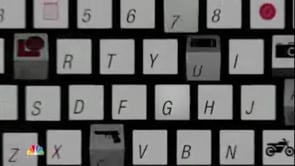
Chuck • NBC
Studio: Imaginary Forces
Title Designer: Karin Fong, Jonathan Gershon, Dana Yee
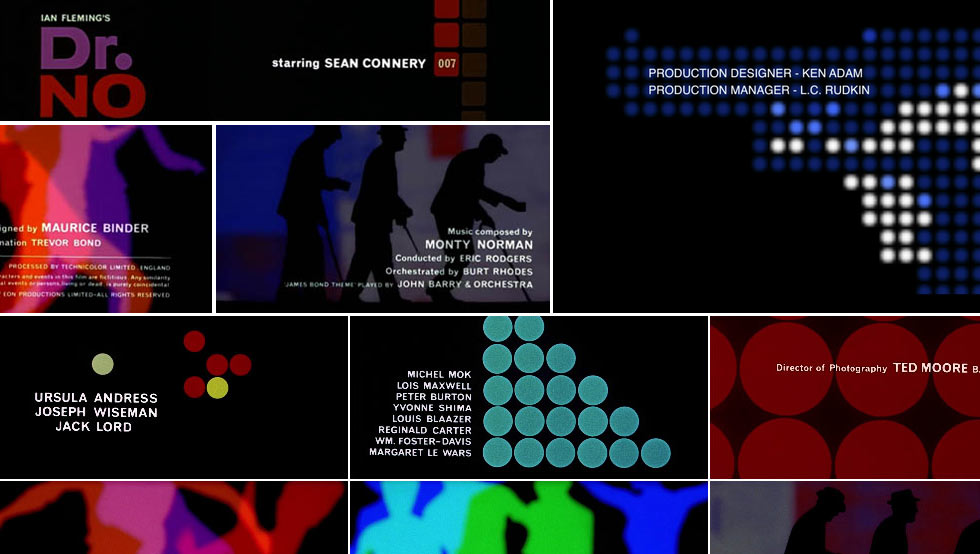
Many of the iconic aspects of a typical James Bond film were established in Dr. No, beginning with what is known as the gun barrel sequence, an introduction to the character through the view of a gun barrel, and a highly stylized main title sequence, both created by Maurice Binder.
Maurice Binder was succeeded by Daniel Kleinman as the title designer for 1995′s GoldenEye and all subsequent James Bond films to date.
By EMILY OBERMAN AND BONNIE SIEGLER
Published: February 21, 2009 New York Times
There’s an Oscar for pretty much every aspect of filmmaking, except one: the title sequences. Titles, though, have always played a significant part in motion pictures. They may have started out as simple black-and-white cards. But in the days before sound, they already did more than identify key players: they communicated dialogue and advanced plot. And as filmmaking evolved, so did title design. Titles have become wonderful bridges from reality into the cinematic world and back out again. At their very best, they are themselves innovative, emotional experiences, microcosms of their movies. Here are some highlights from the history of title sequences:
“The Palm Beach Story,” designer unknown, 1942. This hilarious sequence, full of freeze-frames and set to a mash-up of “Here Comes the Bride” and “The William Tell Overture,” shows the romantic leads beset by strange disasters on their way to the altar. It’s remarkable because it contains all the clues to unlock the screwball comedy’s twist ending.
“Psycho,” Saul Bass, 1960. The graphic slicing through the credits is an abstract representation of the horrors to come. Bernard Herrmann’s score mimics and enhances this violent effect. Like the movie, the title sequence is frightening in its minimalism.
“To Kill a Mockingbird,” Stephen Frankfurt, 1962. The slow pan over the jumbled contents of the cigar box — a man’s pocket watch, crayons, some marbles — lets you inside the minds of the film’s child characters. The modern typography offers a perfect contrast.
“The Pink Panther,” Friz Freleng and David DePatie, 1963. As a stand-alone cartoon starring the Pink Panther, the character created for this sequence, these titles are a perfect tip-off to the silliness that follows. Of course, Henry Mancini also provides one of cinema’s most memorable scores.
“Dr. Strangelove,” Pablo Ferro, 1964. The title sequence that inspired a thousand hand-drawn title sequences. With an orchestral version of “Try a Little Tenderness” playing, this footage of one jet refueling another in mid-air is delicately, beautifully sexual and creepy.
“Seven,” Kyle Cooper, 1995. These titles offer our first glimpse of the movie’s mysterious serial killer — his writings and possessions, his terrifying preparations. The type seems scratched on the celluloid by the killer himself. This sequence is almost as scary as the movie.
IT’S hard to imagine why these and the other exceptional title sequences have never been recognized by the Oscars. We would like to urge the academy to create this much-needed category. In the meantime, we’ve gone ahead and selected the title sequences that should have been nominated for 2008. During the nomination process, we happened upon an interesting trend: filmmakers, more and more, are plunging viewers right into the action and then ending with elaborate title sequences, which serve as epilogues or bonus tracks. Without further ado — or a badly scripted joke — our nominees for Best Achievement in Film Title Design:
1. “WALL-E,” Susan Bradley and Jim Capobianco/Pixar. These poignant end titles, which show humans and robots flourishing on a revived Earth, offer a quick history of art, from cave paintings to van Gogh. They then proceed to retell the entire movie, this time in the pixelated style of old video games.
2. “Tropic Thunder,” Kyle Cooper/Prologue. These titles feature Tom Cruise’s best performance in years as he dances to “Get Back” by Ludacris. They’re intercut with graphic freeze-frames of the rest of the cast.
3. “Slumdog Millionaire,” Matt Curtis. Another dance sequence, this one in grand Bollywood style. After a film full of difficult and sad struggles, this joyous, cathartic sequence, set to “Jai Ho” by A. R. Rahman, gives us hope that the main characters will actually live happily ever after.
4. “Iron Man,” Danny Yount/Prologue. Amazing in a comic-book way, these take us inside the blueprints for Tony Stark’s armor. The soundtrack, appropriately, unavoidably, is “Iron Man” by Black Sabbath.
5. “Mamma Mia!,” Matt Curtis. The end titles toss off the pretense of winding a story around the songs and give us a straight-up, super-’70s tribute, complete with glitzy rainbow prism effects and Meryl Streep singing her heart out.
Emily Oberman and Bonnie Siegler are the co-founders of Number Seventeen NYC, a design firm.
Studio: Digital Kitchen
Creative Director: Danny Yount
Animators: Danny Yount, Dan Brown
Compositors:Danny Yount, Dan Brown
Editor: Shawn Fedorchuck
Producer: Drew Bourneuf
Studio: Digital Kitchen
Creative Director: Erin Sarofsky
Designer: Erin Sarofsky
Animators: Anthony Vitagliano, Shangyu Yin, Rick Thompson, Seth Ricart
3D: Mat Daly, Kenji Yamashita
Editor: Matt Egan
Producer: Colin Davis
True Blood Main Title Sequence
Client: HBO
URL: http://www.d-kitchen.com/project.php?p=128
DK Credits:
Creative Directors: Matt Mulder, Rama Allen
Live Action Direction: Rama Allen, Morgan Henry, Matthew Mulder, Matt Clark, Tevor Fife
Designers: Rama Allen, Shawn Fedorchuck, Ryan Gagnier, Matthew Mulder, Camm Rowland, Ryan Rothermel, Jacques Broquard
Compositor: Ryan Gagnier
Editor: Shawn Fedorchuck
Producers: Morgan Henry, Kipp Christiansen, Keir Moreano
ECD: Paul Mattheaus
EP: Mark Bayshore