Via eyemagazine.com
Title sequences of the 1950s and ’60s grabbed moviegoers with psychological insights, orchestral violence and some lessons learnt from the early pioneers of animation, for whom motion graphics, sound and story were inseparable. By Joel Karamath
Title sequences have reached an unprecedented level of attention, with vast numbers of design studios dedicated to television and cinema motion graphics. Yet the history of the contemporary title sequence stretches back a generation or more, when Saul Bass and Maurice Binder laid the foundations for the modern form, and even earlier, to the short cartoon films of the 1920s and ’30s.
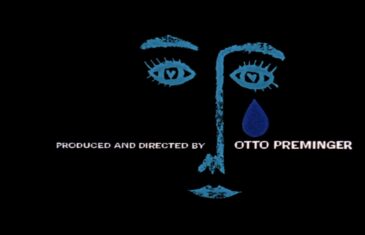
Bass’s titles for director Otto Preminger’s Carmen Jones (1954) and The Man with the Golden Arm (1955) emerged at a time when popular music was consolidating its position as the dominant art form of the twentieth century. The musical impact of both films reflects the zeitgeist of the post-war era that marked the advent of commercial television and advertising – the engine room of consumer society in the us. Television advertising, like the title sequence and the radio ad before it, was defined by music. Yet the influence music had in shaping visual culture on the screen predates this golden age of consumerism.
Sound had always been a goal for mainstream cinema: even in the days of the silent era, sound was unavoidable, complementing and enlivening the screen action via a cinema pianist or, occasionally, a full orchestra. Warner Brothers’ first “talkie” The Jazz Singer in 1927, was a famous success, but it could be argued that the first truly successful marriage of sound and image came with the animated shorts produced soon afterwards, and typically shown as part of the exhibition programmes (feature, b-movie, newsreel, cartoons) to which audiences flocked at that time. One only need look at the names the studios gave their productions to see their debt to music: Merry Melodies, Happy Harmonies, Loony Toons, Silly Symphonies.
Max Fleischer, MGM, Disney and Warner Bros relied heavily upon music for the structure of their short cartoons. Disney’s first major success Steamboat Willie (1928) was Mickey Mouse’s debut in a skit that derives much of its humour from the surreal visualisation of musical cues. In one instance Mickey turns the tail of a goat to the accompaniment of a barrel organ, while in another he plays a cow’s teeth to the sound of a xylophone. When he pulls the string of the boat’s whistle, the instrument forms a mouth and blows.
The most prominent use of music as a catalyst for character and plot visualisation stemmed from Warner Bros, one of the most productive studios (known as “Termite Terrace”), with a huge staff that included some of the greatest animators of all time. Throughout the studio’s heyday in the 1930s, 1940s and early 1950 the prime focus point for artists such as Jones, Avery, Freleng and Clampett would often stem from the sound department, where specialist Mel Blanc created the voices for Bugs, Daffy, Porky et al, and composer Carl Stalling (who had previously worked for Disney on Steamboat Willie) scored the music. While Blanc largely delivered voiceover dialogue and jokes to a script, Stalling was engaged at all stages of production: the interaction between his music, producers such as Leon Schlesinger and animators such as Chuck Jones resulted in a unique body of collaborative work.
The avant-garde films of that time were produced by visual artists who treated the new medium of film as an extension of their respective disciplines: artists such as Man Ray, Ferdnand Léger, Dudley Murphy and Len Lye worked to existing music or silence. Stalling and, similarly, Scott Bradley, head of music at mgm, had helped to create something that was, like the Bollywood musical and the pop promo today, much more than film with musical interludes. It was a specific form, just as grand opera is distinct from opera, or pantomime from dramatic theatre; something that Hollywood would not begin to amend, with the shift from non-integrated to integrated musicals, for over a decade. Further still, these cartoons were products in which the music was both non-diegetic score and diegetic sound effect at the same time, compounding their innovative uniqueness.
Through its publishing division, Warner Bros had an extensive music catalogue, affording the animation studio access to some of the most popular tunes of the day. So it was also the first to seize upon the opportunity of promoting its records visually. The sight of Tom (of Tom and Jerry) crooning Louis Jordan’s “Is You Is Or Is You Ain’t My Baby” marks a marketing strategy that predates MTV by decades. The immediate artistic and commercial success of the animated short in integrating sound, vision and movement supports historian Eric Hobsbawn’s assertion that with the “failure of modernism” advertising and cinema became the true avant-garde.
Stalling retired in 1956 just as television was beginning to usurp the big screen. As genres such as the newsreel and the short moved to the small screen, animation suffered a drastic drop in funding. The elaborate music arrangements of Stalling and Bradley, hitherto scored individually for each production, were replaced by cheaper generic mood pieces, sterile melodies dropped in behind impoverished visuals.
THE START OF A FRANCHISE
As television heralded the demise of quality mainstream animation, cinema began to find a new outlet for the amalgamation it had spawned: the title sequence, which set the mood and provided audiences with a taste of the narrative to come. For the movie-going audience, the title sequence filled a gap left, after the demise of the old exhibition package, by the absence of newsreels and animated shorts.
The way in which this symbiosis between title sequence, score and story can be used to establish motif and character traits is exemplified by the James Bond series (nearly twenty “official” Bond films), started by Dr. No (1962). The Bond title sequence and theme tune are two of the most instantly recognisable cinematic signatures. Despite the obvious impact and lasting impression of Binder’s work, the highly complex mixing and layering of his sequence for Dr. No almost renders the Modernist ethos of his mentor, Saul Bass, redundant: it foreshadows a postmodern tendency to mix and match.
The congested complexity of the Dr. No titles is simplified on subsequent films in the Bond series by separating the original sequence pattern into two individual entities. The opening sequences for From Russia With Love and Goldfinger separate two musically led graphic segments with an opening action scene (unrelated to the movie’s plot) that reduces the harsh juxtaposition of competing graphic images and music of Dr. No . The use of very specific title songs in the Bond movies, as with Goldfinger, also created a separate (and marketable) product.
THE COLLABORATIVE AUTEUR
The postwar period saw a marked shift in film scoring, when composers such as Elmer Bernstein and Bernard Herrmann began to develop a dramatic style that Bernstein described as a move towards a more “emotional . . . inner psychological state”, which relied not so much upon a series of themes as “creating atmosphere”, often without resolution. The brutal violin shrieks of Herrmann’s score for Psycho stand out as one of the most memorable sounds in the history of cinema. Herrmann began his film career with Orson Welles’s Citizen Kane (1941) and died shortly after completing Scorsese’s Taxi Driver (1976). At the hub of an exemplary career in the movies was his eleven-year, eight-film partnership with Alfred Hitchcock. Herrmann’s conception of cinema was an interpretation based upon the balance between sound and image: “The moment that you do a story on film, music becomes almost imperative . . . It is in the nature of cinema that it needs music, theatre doesn’t need music really.”
Herrmann’s statement certainly rings true in relation to the role of the title sequence and is best shown by his work with Saul Bass for Hitchcock, at the end of the 1950s. The collaboration between the three men, though short-lived, was extremely fruitful. Hitchcock is often spoken of as the auteur’s auteur and while there is no doubting his influence on everything he touched, it is equally important to acknowledge the contributions of his regular production crew: Robert Burks’ cinematography, George Tomasini’s editing and the costumes of Edith Head. As much as anything else, Hitchcock’s genius lay in his ability to relay his messages to and through others, most specifically through the work of Bass and Herrmann.
Their first film titles together, Vertigo (1958), provide a perfect example of Hitchcock’s communicative powers, with Bass and Herrmann working separately through the director, Herrmann later scoring to Bass’s visuals. The final construction, like the movie itself, is a slow-moving and uncannily evocative piece that transcends the sum of its melodramatic and repetitive parts.
Vertigo, often considered Hitchcock’s finest work, was quickly followed a year later by North by Northwest, another thriller based upon identity, though not nearly as dark or brooding as Vertigo. Cary Grant’s lead makes play with a witty and romantic script by Ernest Lehman. Bass, Herrmann and Hitchcock conjure an opening score and title sequence that work as a mini-prologue to the film, engaging the audience with related plot themes from the outset. Herrmann’s score is simple and to the point, reflecting the juxtaposition of humour and suspense in the movie with a mixture of high and low notes (flutes to timpani) that represent the opposing forces at work in the film. It has a lighter tone than his score for Vertigo, including a “Gershwin-esque” homage to New York where the film starts, and an exhilarating theme for the chase that covers half of the us.
Bass’s titles are equally engaged with the plot through the use of an animated grid: the names of the stars and production staff follow each other vertically on and off the screen in a game of cat and mouse, prefiguring the precarious positions in which the main characters find themselves. A final twist comes when the grid fades into a shot of a skyscraper, its windows reflecting the street below, a distorted vision of an everyday scene that primes us for a tale of mistaken identity.
VIOLENT HORIZONTALS
Vertigo may be Hitchcock’s most critically acclaimed work and North By Northwest one of the most entertaining but Psycho (1960) is his most notorious, ushering in a new era of film-making and spawning the “slasher movie”. Made on a low budget, in black and white without major stars, it is one of the most influential and imitated ever. Despite several radical changes in production methods, he hired Bernard Herrmann as composer and Saul Bass for the titles. (Bass is also credited as “pictorial consultant”.) Psycho has a special place in twentieth century culture, honoured by several “sequels” with the late Anthony Perkins, a much-derided scene-for-scene 1998 remake (in colour!) by Gus Van Sant and an installation by artist Douglas Gordon, whose 24-hour Psycho clicks slowly through each frame of the original movie.
The film’s content is anticipated in the opening title sequence by the violent music (a string chamber orchestra that Herrmann chose to reflect John L. Russell’s monochrome cinematography) and the slices made in the block capitals of the director’s name, closely followed by the pattern made by slicing a series of vertical bars.
The pinnacle of Bass and Herrmann’s collaboration with Hitchcock would come with one of the most memorable scenes in movie history. The condensed montage of shots in the shower scene – which took the best part of a week to film, placing the camera in over 70 positions – is on screen for little over a minute. It was storyboarded, shot and edited by Bass, who also had to persuade Hitchcock to include Herrmann’s score: the director had originally intended to screen the scene without music (see extract on p41). Less than halfway through the movie, they created a cinematic climax that has never been bettered.
ALL THE ANIMALS COME OUT AT NIGHT
Psycho marked the apex and the conclusion of the collaboration between Hitchcock, Bass and Herrmann: the three were never to work as a team again. Bass and Hitchcock (whom Bass said had “taught him the art of film-making”), would fall out, some say over their differences on Psycho. Hitchcock’s next picture, The Birds (1963), featured a title sequence by James Block and electronic music by Oskar Sala. (Herrmann acted as a consultant.) A few years later he would be removed from his position as the composer on Torn Curtain (1966) by Hitchcock, never to work with the director again. All three continued to produce good work, but never quite reached the symbiosis of their work on Vertigo, North by Northwest and Psycho. Bass went on to produce two of his most outstanding creations, Walk on the Wild Side (1962) and Nine Hours to Rama (1963), soon after the split from Hitchcock, yet these movies highlight the pitfalls of working outside the confines of a tight team. Both sequences are superbly crafted entities (working with scores by, respectively, Elmer Bernstein and Malcolm Arnold) that work as separate narrative interpretations and represent their films’ stories in miniature. Yet Bass’s titles are considered by some critics to be more memorable than the films.
Herrmann’s final score for Taxi Driver symbolises the gothic sleaze of mid-1970s New York. Without overtly graphic titles, the saxophone-led cues intensify the glaring montage of traffic signals, street signs, cinemas, theatres and storefronts in Manhattan, while the more orchestral passages glance back to the emotional turmoil of Scottie in Vertigo. The parallel nature of Herrmann’s work to Bass and Hitchcock on Vertigo was best summarised in reference to a composition made over twenty years later. When Martin Scorsese was asked about the importance of Herrmann’s score for Taxi Driver, he said: “It provided the psychological basis throughout . . . a vortex that never comes to completion. Just when you think it’s finished it starts all over again.”
Both Bass and Herrmann worked best with visionary auteurs brave enough to let them interact with their work on a intellectual, physical and emotional level, enabling them to create work that not only complemented but raised the films on which they collaborated to new levels of emotional richness.
Dr No
Title sequence from Dr. No, 1962. Design: Maurice Binder. Music: John Barry and Monty Norman. Animation: Trevor Bond. Director: Terence Young. Producers: Harry Saltzman, Albert R. Broccoli. © 1962 Danjaq, LLC and United Artists Corporation.
In Dr. No Maurice Binder sows the seeds for what was to become the classic Bond opening: a white circle appears on the screen, to the accompaniment of primitive electronic music – simple bleeps like test tones. The circle manifests itself as the spiral of a gun barrel (or the iris of a lens) in which “Bond” is focused. He beats his would-be assassin to the draw and with a single shot turns the screen red. This screen fills with flashing multicoloured dots (animated by Trevor Bond) that finally form the title of the film and serve as an accompaniment for the main actors’ credits. The third segment of the titles introduce the cavorting silhouettes of go-go dancers that later became a Bond hallmark. Here they are intended to evoke the “exotic” Caribbean, where the film is set, and London in the swinging 1960s. There is then a dissolve to the fourth and final segment as the dancers fade into the silhouettes of three “blind” men loping across the screen from left to right, which in turn dissolve into the live footage of the same three characters, soon to be revealed as vicious assassins, as the story begins.
The four sections of Binder’s opening are paralleled by four distinct soundtrack segments. In the first part, Binder’s dot logo is seen accompanied by high-pitched electronic test tones (which, like the dot, establishes a link between Bond, the film and the onset of the computer age). A gun shot then ignites the dot-matrix spectacular, introducing the title of the film, in the second segment, along with Monty Norman’s Bond theme, arranged by the hastily recruited John Barry with its long, chromatic string line and twanging guitar. Stage three uses an exotic bongo rhythm for the dancing figures, which then develops into a calypso version of “Three Blind Mice”, a tentative first use of the Bond device of using a theme song linked to the story (“Diamonds Are Forever”, “The World Is Not Enough”).
Goldfinger
Title sequence from Goldfinger, 1964. Design: Robert Brownjohn. Music: John Barry. Director: Guy Hamilton. Producers: Harry Saltzman, Albert R. Broccoli. © 1964 Danjaq, LLC and United Artists Corporation.
By the time of Goldfinger, which had a budget at least five times that of Dr. No, the James Bond title formula was firmly established. The short opening iris segment is largely copied from Dr. No, except that it dispenses with the electronic bleeps and uses the John Barry version of the Bond theme throughout. A four-minute plus action scene follows that establishes Bond’s credentials as a resourceful spy and “ladykiller” – glimpsing a would-be assailant in a lover’s eye in mid-clinch, he spins round so that the girl takes the blow.
The pre-credit sequence works as a mini-Bond movie that re-establishes the 007 persona for fans and provides a swift introduction for newcomers. Robert Brownjohn’s credit sequence shows scenes from the movie projected on to a woman’s golden-painted body (the villain’s nubile assistant is sadistically murdered by “epidermal asphyxiation” early in the plot) to the accompaniment of Barry’s theme song, with lyrics by Anthony Newley and Leslie Bricusse sung by Shirley Bassey. This was the first Bond movie to feature a full-blown song over the titles – From Russia With Love uses an instrumental version of the theme song. Goldfinger could be seen as the first complete Bond sequence, as well as the aesthetic pinnacle of the franchise, setting a template for the series that, though often imitated, has rarely been surpassed.
Vertigo
Title sequence from Vertigo, 1958. Design: Saul Bass. Music: Bernard Herrmann. Director: Alfred Hitchcock. © Universal Studios.
In Vertigo, the acrophobic protagonist Scottie (James Stewart) obsessively recreates Madeleine, for whose suicide he feels responsible, in the person of the living Judy (Kim Novak). Bernard Herrmann scored the “Prologue” music to Bass’s visuals, constructing an uncannily evocative piece that far outweighs the sum of its parts. Indicative of what David Toop described as the “intellectual” impact of images and text in relation to the “emotional” content of music, the sequence manages to convey issues inherent in this slow, complex film through simple means.
As the studio logo fades we hear a harp initiate a repetitive melody which is taken up by the violins. Bass’s images enter at a point where low strings have just introduced a sense of foreboding. Bass crops Novak’s face tightly, employing what film-maker Barney Cokeliss described as a “cinematic blazon”, a technique later deployed to great effect by Scorsese at the start of Taxi Driver, when Travis Bickle (Robert De Niro) is introduced through the window and rearview mirror of his taxi. With his Vertigo titles, Bass suggests the notion of a constructed woman, giving us fragments rather than a whole. Herrmann’s melody continues, but is interrupted by a Wagnerian surge of horns, as credits for the lead actors, director and title appear, before returning to its melancholic cycle.
Appropriately enough for a film about image and identity, the title appears over a full frame of Novak’s eye. As we are drawn into the centre of her iris a small, animated vortex begins to spiral and grow until it engulfs the whole screen, undergoing a series of colour changes. This spiralling icon, coupled with the repeating melody, provides a theme that runs throughout the movie: that of revisiting and re-inventing the past. The spiral represents Scottie’s vertigo, the coil of hair on a woman’s head in an oil portrait, a bouquet of flowers and the winding wooden staircase of the bell tower from which Madeleine falls to her death. Bass’s colour changes for this graphic are equally significant. The icon first appears in Novak’s eye tinted red before trawling through the spectrum, a cue to the importance Hitchcock gives to colour throughout the movie as Scottie, the ultimate fall guy, is sucked into an emotional void.
Psycho
Title sequence from Psycho, 1960. Design: Saul Bass. Music: Bernard Herrmann. Director: Alfred Hitchcock. © Shamley Productions.
Psycho will always stand as one of Hitchcock’s masterpieces but there can be few of his films which have had such a direct, creative input from outside sources. Without Herrmann’s score, Psycho would be something completely different, something less, while Bass picks up all the themes that are established in the opening credits, right through to the midpoint climax of the movie. Paul Hirsch commented that “the extreme emotional duress is due entirely to the music”. What we see is not just heightened by the music – it is taken to another level. The shrieking violins are the externalisation of Norman Bates’s internal angst. Hitchcock’s brief to the composer, for a light jazz score, was thankfully ignored.
As with Vertigo and North By Northwest the score sets up a repetitive momentum that keeps bringing us back to the same place over and over again, but unlike the two previous films, there is no genuine respite. The introduction is abrupt and jumps in almost with a climax; everything about the score is an attack. The repetition does not take us around in a circle but is a constant onslaught, wave after wave that cannot be resisted. Visually, the violence to come is relayed in the opening sequence by horizontal slashes that rip through the pure white titles and credits on screen. As in The Man With The Golden Arm, solid white bars appear but they offer little defence from this attack. The Powers of Ten-style zoom into the doomed heroine’s bedroom window implies that this is just one of many stories in this particular naked city.
First published in Eye no. 39 vol. 10, 2001
http://www.latrobe.edu.au/screeningthepast/20/novelty-title-sequences.html
There were things that could be done with film, it was crazy not to do them.
title designer Wayne Fitzgerald [1]
In 1976 Saul Bass designed the opening title sequence for That’s Entertainment Part II (Gene Kelly) and in doing so created a piece of film that was about titles sequences, as well as being one itself. The film’s compilation format of classic clips from Hollywood musicals inspired him to emulate a wide-ranging series of titles from the classical period and, in particular, the 1930s. The result is a joyous celebration of a range of titling styles designed to entertain in their own right, sometimes imitating existing sequences, and sometimes inspired by what Bass calls the “mythic memory” of sequences that could or should have been.[2]
This sequence highlights two important issues. In its pastiche of title sequences from the 1930s it shows some of the sorts of novelty sequences produced at that time. It is historically important to remember that such sequences existed since many of the journalistic articles written about film titles in recent years present an inaccurate picture proposing that film titling was universally dull and conservative until 1954 when the form was revolutionised by Bass in his design for Otto Preminger’s Carmen Jones. Typical of such articles is David Thomson’s which claims that, “For decades before the 1950s, movie credits had meekly followed whatever standard treatment prevailed at every studio… The music over the credits sometimes had the mood of the picture to come, but the graphics themselves were classical lettering on a bland background.”[3] As I will show, the history of title sequences is far more lively and varied than this.
The second issue relates to what is often perceived as a key purpose of title design, namely finding ways to prepare the viewer for the experience of watching the coming film. In That’s Entertainment Part II, pleasure and function are seamlessly blended in a sequence that names the film, credits the cast, hints at what will follow and sets an appropriate tone, as well as providing a stylistic history lesson. David Geffner has argued that title sequences “form a kind of contract, outlining the filmmaker’s intentions and, for better or worse, setting up expectations that the audience, almost subliminally, will demand to be met.”[4] This attitude can be discerned in the design of many sequences described in this article, but I will also show that in other sequences the importance of this function is displaced by other features. Indeed, the common factor of the sequences featured here is a flamboyant exhibitionism that revels in its own cleverness. In this respect, these sequences differ considerably from the attitudes to film titling that later rose to domination.
Experimentation with striking and unusual title sequences began as early as the late 1910s, but it was the 1930s when an explosion of ideas and techniques occurred that consolidated the role of the title sequence as something more than a list of names. A wide range of styles and techniques were used at this time, many of them indigenous to the period. Although many sequences were designed with relative stylistic economy, others seemed fascinated instead with the potential of the medium for exploring techniques of direct address and self-reflexivity. These highlight a more than usually complex relationship between themselves, the main part of the film they introduce and the process of its production.
In this article I explore a selection of sequences that foreground the problematic relationship between the exhibitionism of title sequences and the need to construct a full diegesis. All of these sequences are self-reflexive, a process normally manifested through the introduction of film titles into the diegetic space, or through references made to them either by fictional characters in the film or a member of the production crew.
Such a collapsing of the boundaries between the diegetic and non-diegetic space contravenes a convention that many theorists, such as Bordwell, Staiger and Thompson, have looked upon as central to the ‘classical style’, although these authors acknowledge that exceptions exist.[5] This convention is that the diegetic space should be internally coherent and that filmic technique should not conspicuously impinge upon it. These sequences raise questions about such ways of understanding the construction and pleasures of Hollywood cinema. Are title sequences an entirely different medium from the films they introduce, or does their failure to conceal their artifice and their frequent promotion of non-narrative pleasures represent an intensification of a more widespread mode of film practice in which a narrative structure and apparently seamless diegetic construct exist merely as an organisational principle in which other pleasures are contained?
Many films of the studio era, and indeed the majority of films now, do indeed tend to avoid actively drawing attention to the fact that the diegetic space is an artificial entity constructed in the process of the film’s production. Perhaps the most notable exception to this rule is film comedy. Henry Jenkins has argued that, “the comic film tended to lag behind the rest of American cinema in its acceptance of classical Hollywood norms, remaining one of the places where marginal film practices enjoyed the greatest acceptability.”[6] Steve Seidman’s excellent study of comedian comedy cites a wide range of instances where diegetic boundaries have been rendered problematic, and one of the foremost sites he identifies for using such a device is the opening (or sometimes the end) credits sequence.[7]
The practice of foregrounding the process of production is a feature also found in many avant-garde films. It is not unusual for the materiality of the title cards to be emphasised in such films, as lettering is scratched or painted on film, inscribed onto a physical object, or cards are positioned or removed by hand. Examples can be seen in Color Cry (Len Lye, 1953), Little Stabs at Happiness (Ken Jacobs, 1959-1963) and Gulls and Buoys(Robert Breer, 1974). Moreover, title sequences that rely heavily upon cinematic trickery show a preoccupation that Tom Gunning has observed in the writings of the early modernists, namely “a fascination with the potentialof the medium.”[8] Observing that one feature of early cinema and the avant-garde alike is “its freedom from the creation of a diegesis, its accent on direct stimulation”, Gunning identifies a sensibility that he terms “the cinema of attraction.”[9] The attitude that he describes can be seen to resonate through the titling innovations of films cited in this essay.
Although there are parallels between such instances and features of some mainstream comedies, we should be wary of inferring too close a commonality between the two forms. Steve Neale and Frank Krutnik have argued that “neither comedy nor the comic can be regarded as inherently subversive or progressive, or as inherently avant-garde… [since] the level of generic verisimilitude [in expecting the unexpected] accounts… for the nonavant-garde character of even the most formally adventurous comedies.”[10] Accepting the validity of their argument, we can nonetheless recognise that in some of the title sequences this essay describes, features strongly associated with both classical film comedy and avant-garde cinema are brought together.
Some of the sequences I will describe are from comedies, and in these we can detect some strong consistencies between the title sequence and the rest of the film in the ways in which the viewer is addressed. Most of them are from other genres though, and would therefore seem to be at odds with the films they introduce. Even if we allow that title sequences, like certain film genres, are a site in which self-reflexive devices have been normalised, we are still left with a situation where the artificiality of the film construct is highlighted to a degree that raises questions about the validity of arguments which hold that mainstream films, of the classical period at least, do all they can to present themselves as hermetically sealed entities.
The self-reflexive sequences discussed in this essay can be placed into three basic categories. The first two are quite similar to each other in that they both involve titles inscribed onto physical objects. In the first case there is the insinuation that these objects may belong within the diegetic space but are not unequivocally placed there. In the second group are sequences where the credit titles are inarguably placed within that space. The third group involves some interaction between the credit titles and either the characters in the film or its production crew. Perhaps the most interesting feature of these sequences is the range of ways in which they call into question the nature of the diegesis and the means by which the films structure and present this organisational system.
Traditionally, credit titles have collided with the diegetic image in one of two ways. Either the whole sequence has been marked off from the diegesis by placing the lettering on a totally different background, such as a plain board or piece of paper, or else the lettering has been superimposed over diegetic footage without any attempt to conceal the independence of one plane from the other, or to conjoin them in such a way as to suggest that their origins might be linked. The films described below provide exceptions to this rule.
Defining the boundaries of the diegesis can be a difficult task in itself, although the meaning of the term seems fairly straightforward at first glance. For a popular textbook definition we may as well take the one provided by Bordwell and Thompson in Film Art: “In a narrative film, the world of the film’s story. The diegesis includes events that are presumed to have occurred and actions and spaces not shown onscreen.”[11] When a film opens, the viewer has no frame of reference, however. How is s/he supposed to assess the status of the background image during a title sequence that comes right at the beginning of a film, as many of them do? If the background is plain, or a painted picture, then knowledge of convention may suggest that after the titles there will be a cut to a live action scene that has no spatial link to the title card. Yet as I will later describe,Whirlpool (Otto Preminger, 1950), provides one exemplary illustration of just how easily the viewer can be tricked.
Live action backgrounds and the presence of three-dimensional objects during the titles present a greater problem for the viewer. A comparison of three title sequences, which share strong similarities with each other, will illustrate this difficulty: My Darling Clementine (John Ford, 1946), The Cat and the Fiddle (Lloyd Bacon, 1933) and You’ll Never Get Rich (Sidney Lanfield, 1941). These belong to a small but diverse group of films that present their opening titles on billboards or signposts. To illustrate the point in hand, the pertinent feature of these sequences is the varying relation between the signposts and/or billboards in the title sequence and the space of the subsequent film. My Darling Clementine uses titles scorched into a single wooden signpost. This is the only physical object in the frame during the title sequence, which ends with a cut. There is therefore no suggestion that the post is located anywhere within the diegetic space (save only that its style suggests rural origins). The Cat and the Fiddle shows cars circling a roundabout, in the centre of which is a notice board that a man approaches. We see that it displays a poster advertising Ramon Novarro and Jeannette McDonald in The Cat and the Fiddle. The camera tracks into this poster and freezes, after which the board rotates to show two further posters/title cards. As in My Darling Clementine, a cut is used to separate the title sequence from the rest of the movie. You’ll Never Get Rich is by far the most elaborate of the three sequences. It shows a man being chauffeured along a country road. The passenger asks the driver to slow down as, watching from the window, he sees a row of signs along the roadside on which there appear film credits as well as pictures of the top-billed stars. Presently credit titles start to appear on fences and buildings too. After the last one, the film cuts back to the passenger, who tells his driver, “All right, go ahead. Thank you.” At this point, as in the other sequences, the film cuts to a different location. It is a city scene and is therefore evidently a different space. Yet a street sign passed by a car establishes this new location, the iconography of the shot thus linking it to the previous sequence.
In these films, we see three examples of titles inscribed upon physical objects that have no clear spatial link to the actual space in which the narrative occurs. There is a gradation between the first sequence, which is completely divorced from any narrative space, and the second, which suggests a similarity between the space of the titles and the following scenes by including some action in the title sequence. In the final example, there is a strong continuity with the construction of the subsequent space and action, due to the presence of dialogue and a minimal narrative content during the titles as well as loose graphic matching between the two spaces. Although in all these examples a cut separates the space of the titles from the main part of the film, some films discussed later in the essay proceed without any intermediary cut. Instead of being insinuated into a mock-diegetic space, their titles are patently positioned within the very space where the narrative action occurs.
The practice of inscribing titles onto physical objects positioned outside the diegetic space is most commonly associated with the trick and novelty title sequences of the 1930s. The sequences discussed in this section are designed in such a way as to suggest the possibility that the space presented may be diegetic though. Instead of using motionless two-dimensional artwork – a far more common technique of the era – they use live action backgrounds that do indeed turn out to have strong graphic connections with spaces seen subsequently.
One of the sequences that most successfully insinuates titles into the diegetic space without ever framing them in the same shot as the narrative action is The Great Ziegfeld (Robert Z. Leonard, 1936). Its titles are spelled out in lights on a large and elaborate scaffolding structure across which the camera pans, pausing briefly on each set of titles. A cut at the end of the sequence provides the transition to the first unambiguously diegetic location: a fairground at night. The nocturnal setting and elaborate incandescent structures of the carnival park are sufficiently similar to the illuminated titles to erode the boundaries between the two spaces.
Boy Meets Girl (Lloyd Bacon, 1938) uses the device of a book to create a visual continuity between its opening title sequence and the diegetic space. A technique used in several films, here the book is on the very verge of placement within the diegetic space. Although it does not appear in any scene of narrative action, it is discovered through a track-in to a desk artistically littered with miscellaneous items including a typewriter and several spilling film cans that mark the location as a screenwriter’s office. This, of course, is a film about screenwriters. In case the other clues leave any doubt remaining, the document is entitled, ‘Final Script’, with the film’s main title and credits revealed on the inside pages.
In other sequences, we discover the credit titles in slightly less expected places than the relatively popular sites of signposts, billboards or book pages. Most of these sequences are enormously inventive. One example of a stock trick-title sequence can be seen in Her Man (Tay Garnett, 1930), where titles scraped into sand are washed away by incoming waves. Maytime (Robert Z. Leonard, 1937) provides another charming example. In this sequence two techniques are used. For the first and last groups of titles, blossom petals fall from a tree onto the surface of a running stream. There they form the letters of the titles before dispersing with the movement of the water. Intermediate titles are cut into the bark of the tree trunk. Explicit homage was paid to this sequence in the titles for That’s Entertainment Part II, which also included a variant on waves washing titles from the sand, although Bass admitted that he had not seen Her Man or indeed any other film using the device.[12] A handful of similar, but more crudely executed examples can be found in later years. For Ali Baba and the Forty Thieves (Arthur Lubin, 1944), titles painted on a wall are doused by upturned water jars. In Joan of Paris (Robert Stevenson, 1942), when a waiter opens a champagne bottle with an audible pop, its content brims over, acting as wipes (through a rather crude cheating) between the sets of titles that seem to be printed on the bottle label. These films differ from such examples as The Great Ziegfeld and The Cat and the Fiddleinsofar as the act of removing the credits means that they have to be miraculously replaced somehow. If the more perfectly realised examples, such as Maytime, instil a sense of the marvellous, in other cases the crudity of the cinematic trickery used to achieve this effect can be destructive of the illusion that the credits somehow appear in ‘real’ space and time. The separation between the space of the title sequences and the subsequent action is thus defined not only by editorial strategy but also by perceptual factors centred upon the verisimilitude of the illusion.
Some films unquestionably inscribe their titles into the diegetic space by positioning the text as part of the scenery in which the action occurs, occasionally proceeding without even a cut at the end of the sequence.Whirlpool provides an example that is both unusual and immensely effective. The opening titles appear in black upon an almost neutral background, which is decorated only by a very faint repeating pattern. The pattern crawls upward at the same pace as the lettering, rendering beyond doubt the fact that the text is not superimposed but painted upon it. After the final credit, a swish-pan takes us all the way back up the paper to the start of the credits list, although motion blur means that the titles are not legible during this return journey. As the paper crumples up, it becomes evident that it belongs to a roll of wrapping paper handled by a shop assistant. The shot has proceeded from the credit list to the shop girl without any visible intermediary cut. The most curious feature of this sequence is not its placement of titles on a material that is indisputably part of the diegetic world but rather the postponement of this discovery until after the opening titles have ended.
Where The Sidewalk Ends (Otto Preminger, 1950) provides another interesting example in a film by the same director. The movie opens with titles hand-painted on a sidewalk, seen under the feet of a man who walks across them. A second man lingers with his feet upon the main title before the camera pans with him as he steps off the edge of the pavement and over a rivulet of water pouring into the gutter. Although there is editing in the sequence, which includes action and diegetic sound, the space of the sidewalk is clearly consistent with continued footage of the city during a rainy night.
Some sequences use for their main title what we might call a ‘found artefact’ – an object that exists elsewhere in the filmic space and which names the film, thereby obviating the necessity of creating a specific title card. One such instance can be found in Verboten! (Samuel Fuller, 1959), in which a group of American soldiers discuss the meaning of the word, which appears on a signpost. A similar device is used in Sunset Boulevard(Billy Wilder, 1950), where the main title is painted onto a kerbstone, an already existent street sign that may feasibly have existed as an artefact outside the film as well as within it. Portrait of Jennie (William Dieterle, 1948) is limited to a single title, this time shown as a picture gallery catalogue entry – “Portrait of Jennie, dated 1934, h.30: w.25 inches” – the image accompanied by a spoken discussion of the painting. Each of these sequences achieves an interesting subversion of the normal relationship between title sequences and the films they introduce without employing the levels of flamboyant cinematic trickery that were seen with relative regularity in 1930s cinema.
Some films go further yet and depict the very act of creating the titles. As the process of writing is made visible, the act of directly addressing the audience is emphasised and the narration foregrounded. One example from the golden age of novelty title sequences is Carefree (Mark Sandrich, 1938). In that film, a white background is covered over with streaky black paint, in which a finger traces the credits. The lettering is then scrubbed out by a pair of hands before the finger writes out the next set. A range of decorative patterns are created as the titles are erased by different hand movements each time. I Love Melvin (Don Weis, 1953) provides a significant variation on the idea in that the author of the titles is identified. The film’s star, Debbie Reynolds, is shown dressed in a ballet costume and looking into a dressing room mirror in order to apply her lipstick. Her reflection catches the eye of the camera. She smiles, her mirror image looking straight at the audience, and writes the main title in red lipstick on the glass.
Perhaps the most interesting feature of this particular sequence is that, at this point in the film, Debbie Reynolds can be read as appearing in her purest form – as herself, as a star. She has not yet fully taken on the role of her fictional character in the film, although she is dressed for the part. The way that her eye catches the camera so that she appears to look straight at the audience circumvents any fictional distance and allows us to imagine that it is Reynolds, not her character, addressing us with her stare. Her act of applying lipstick also suggests the preparation for a performance rather than the performance itself. By such means, the transition between the film’s production process and its fiction is made manifest, not least through the process of writing the titles before our very eyes.
To Kill a Mockingbird (Robert Mulligan, 1962) handles the interaction between character and titles is a slightly different fashion. The film begins with a child’s hands opening a box, which contains all sorts of oddments. This, we learn later in the film, is Scout’s treasure chest. Scout, unseen in this sequence except for her hands, sings to herself as she removes a crayon from the box and starts to colour over a sheet of white paper, which reveals the main title. The fact that in this sequence the character is responsible for making visible the title, rather than actually writing it as a communication to the viewer, is a significant difference from Carefree and I Love Melvin. The lettering is something that is already there for her to discover. Another hand can be detected therefore: that of the filmmaker who has set the scene.
There are also many films in which the act of inscription may not be visible but where characters interact with the titles. Since this invariably produces a humorous effect, it is normally used in film comedies although there are occasional exceptions to this rule. Using credit titles as comic props has particular associations with animation. The most famous examples are surely The Pink Panther (Blake Edwards, 1964) and its sequels, which show the Panther toying with the letters, just as the anthropomorphised letters sometimes toy with him, as when his wolf whistle at Claudia Cardinale’s title provokes a hand to appear from the credit in order to issue a resounding slap. Earlier and equally entertaining examples exist though. One of those went so far as to create its main titles out of the characters themselves. In Abbott and Costello Meet Frankenstein (Charles Barton, 1948), two skeletons (one short and fat, one tall and thin – the proportions of the stars) collide with one another when running frantically from Frankenstein’s monster. This mishap causes the complete collapse of their frames into separate bones arranged as words. In films such as these, which are live-action bar the credits, there is clearly no blurring of diegetic boundaries, but merely a subversion of the credit titles’ normal form and purpose. There are also some live action title sequences that do similar things however, and these are more problematic in terms of actors slipping back and forth between a plainly narrative role and an ambiguous status somewhere between character and star. Indeed, interaction between actors or characters and title lettering is often accompanied by a direct address to the audience, just as Debbie Reynolds catches the eye of the camera in I Love Melvin.
One film where this occurs is The Court Jester (Norman Panama and Melvin Frank, 1955). Its title sequence is dominated by Danny Kaye’s performance of a song discussing salient features of the forthcoming movie whilst choreographing the appearance, disappearance and motion of some of the titles through his own movements. Another interesting sequence introduces Will Success Spoil Rock Hunter? (Frank Tashlin, 1957), which opens with an extreme long shot of a one-man orchestra playing all the instruments for the Twentieth Century Fox fanfare. A closer shot shows him to be the star of the film, Tony Randall, who introduces himself to the audience. Credits materialize as he clicks his fingers, but his frequent mistakes cause the wrong titles to appear so that he eventually screws his notes up in frustration. At one stage he announces, “The title of this movie is The Girl Can’t Help It. No – we made that!” This is the first of several references to the director’s earlier releases that punctuate a film that is extremely self-reflexive throughout.
Self-reflexive jokes in title sequences normally involve the titles themselves in some way, although this is not always the case. One very original variant occurs in Monkey Business (Howard Hawks, 1952). In this sequence we hear the voice of director, although the only direct address to the audience is in the standard function of the titles themselves. There is no physical or verbal interaction between character and lettering. Nevertheless, there is a confusion of the boundaries between diegetic and non-diegetic space and, perhaps more interestingly, a literalising of the function of the title sequence as an opening, a transition into the diegetic world. In Monkey Business, the diegesis breaks in on the non-diegetic space. The background shows a still photograph of the front of a house, its front door squarely facing the camera. Whilst we soon discover that this image is diegetic, at first it seems as flat as the title lettering so that the status of the image is initially questionable. The otherwise conventional unrolling of the credits in superimposition upon this flat, unassuming backdrop is interrupted twice as the door opens from within and Cray Grant emerges, shifting the image into three-dimensionality. The director’s voice interjects, “Not yet, Cary!”, significantly using the actor rather than the character name. Each time this happens, Grant retreats into the house and closes the door behind him. At the end of the sequence, he makes an identical entrance and this time the film is allowed to progress.
In foregrounding the act of direct address and, in some cases, showing the real or ostensible origin of the credit titles, the sequences described in this essay highlight, to varying degrees, the act of showmanship involved in introducing a film to its audience. Perhaps more significantly, they sometimes go so far as to emphasise that the film is indeed just a film. It is show, an illusion forged of the same materials as the titles themselves. This is a message made manifest in those titles that intrude into the diegetic space or even, as in the case of Monkey Business, a diegesis that intrudes into the space of the titles.
It might be argued that there is nothing particularly distinguished about this feature. Many films, even so-called classical films, have self-reflexive moments, or characters that seem to burst out of the diegetic space to perform for the viewer, seemingly unmediated by plot and character – a common feature of musical numbers, for instance. Indeed, since it is comedies and musicals that seemingly have the least regard for the proprieties of ‘classicism’, it is hardly surprising that many of the most extreme examples of using titles as objects and violating the diegetic boundaries have been found in these genres. The opposing logic of real-world laws and cinematic possibilities provides the meat of the joke. Nevertheless, the non-comic effect of this process in films such as Where the Sidewalk Ends and Verboten! at least indicates that in the title sequences of film genres more circumscribed by the constraints of ‘classical Hollywood’ convention, the level of experimentation permitted by comedy is not entirely excluded.
The legitimisation of a whole range of styles and techniques can be partly explained by the fact that the presence of the written titles (and they are almost always written) delays the moment at which the viewer can be psychologically sucked into the diegetic world, unhampered by overt narrational marks.[13] The way that the credits announce the film crew, and the stars in particular, also means that they refer directly to elements external to the film, so that title sequences have sometimes been written about as existing within the domain of what Gerard Genette has called ‘paratext’, which mediates between text and extratext, that is between diegetic elements and external features.[14] Already appealing to the audience directly by virtue of the title lettering, and by the promotion of extratextual features, some films seek to make the most of the opportunities offered by the impossibility of showing only a diegesis and to make a feature of their exhibitionism instead. Such an attitude has helped to render the title sequence a site in which the usual ‘rules’ of mainstream film do not apply, in which ‘anything goes’. In an era when the innovations of title designers before Saul Bass have come to be largely overlooked, the longstanding exploration of the different possible relationships between title sequences and the films they introduce deserves to be reappraised.
This article was first published as “Innovative Vorspanne und Reflexivität im klassischen Hollywoodkino”, in Alexander Böhnke, Rembert Hüser and Georg Stanitzek (eds.), Das Buch zum Vorspanne: ‘The Title is a Shot’(Berlin: Vorwerk 8, 2006), pp. 90-101, translated from English to German by Andrea Kirchhartz. It appears here with minor revisions.
[1] Wayne Fitzgerald interviewed in Dean Billanti, “The names behind the titles”, Film Comment, vol. 18, no. 3, May/June 1982, p. 68.
[2] Saul Bass, “The ‘compleat film-maker’ – from titles to features”, American Cinematographer, vol. 58, no. 3, March 1977, p. 290.
[3] David Thomson, “The man with the golden pen”, Independent on Sunday, 21st June 1998, p. 19.
[4] www.imaginaryforces.com (accessed 23 May 2001).
[5] David Bordwell, Janet Staiger and Kristin Thompson, The Classical Hollywood Cinema: Film Style and Mode of Production to 1960 (London: Routledge, 1985, 1988), pp. 21-22.
[6] Henry Jenkins III, “Fifi was my mother’s name!: anarchistic comedy, the vaudeville aesthetic, andDiplomaniacs“, Velvet Light Trap, no. 27, fall 1990, p. 9.
[7] Steve Seidman, Comedian Comedy: A Tradition in Hollywood Film (Ann Arbor: UMI Research Press, 1981), esp. pp. 34-35.
[8] Tom Gunning, “The cinema of attraction: early film, its spectator and the avant-garde”, Wide Angle, vol. 8, no. 3/4, 1986, p. 64.
[10] Steve Neale and Frank Krutnik, Popular Film and Television Comedy (London: Routledge, 1990), p. 93.
[11] David Bordwell and Kristin Thompson, Film Art: An Introduction (NY: Alfred A. Knopf, 1986), p. 385.
[13] A handful of films in this period made use of spoken or sung credits, such as Sweet Rosie O’Grady (Irving Cummings, 1943), Meet Me After the Show (Richard Sale, 1951) and The Road to Bali (Hal Walker, 1952), although these normally occurred simultaneously with written titles, as they did in these examples. Orson Welles famously spoke the credits to The Magnificent Ambersons (Welles, 1942), but did so at the end rather than the beginning of the film, which opened with only two brief title cards.
[14] For an example of this approach, see Leopold Joseph Charney, Just Beginnings: Film Studies, Close Analysis and the Viewer’s Experience (Ann Arbor, MI: University Microfilm International, 1993).
Saul Bass (May 8, 1920—April 25, 1996) was an American graphic designer and Academy Award-winning filmmaker, but he is best known for his design on animated motion picture title sequences, which is thought of as the best such work ever seen.
During his 40-year career he worked for some of Hollywood’s greatest filmmakers, including most notably Alfred Hitchcock, Otto Preminger, Stanley Kubrick and Martin Scorsese. Amongst his most famous title sequences are the animated paper cut-out of a heroin addict’s arm for Preminger’s The Man with the Golden Arm, the text racing up and down what eventually becomes a high-angle shot of the United Nations building in Alfred Hitchcock’s North by Northwest, and the disjointed text that raced together and was pulled apart for Psycho.
Saul Bass designed the 6th AT&T Bell System logo, that at one point achieved a 93 percent recognition rate in the United States. He also designed the AT&T “globe” logo for AT&T after the break up of the Bell System.