“Motion Plus Design” is a non-profit project which aims to create the first exhibition center dedicated to Motion Design in Paris, France. Students, professionals and anyone interested can discover artists, meet them and learn a thing or two. This centre will also provide an opportunity to promote artists in other design departments so the different graphic design worlds could cross.
“Motion design is already present in all parts of our lives. Yet, no place is dedicated to celebrating motion design. When we realised this, we came up with the idea of founding the world’s first Centre dedicated to the world of motion design.”
The video below has for goal promoting this interesting idea and takes a look at the growth of Motion Design throughout the century:
“Motion Plus Design” – the first exhibition center dedicated to Motion Design in Paris!
Posted by motionVFX Team
January 30, 2012, at 10:54 PM
“Motion Plus Design” is a non-profit project which aims to create the first exhibition center dedicated to Motion Design in Paris, France. Students, professionals and anyone interested can discover artists, meet them and learn a thing or two. This centre will also provide an opportunity to promote artists in other design departments so the different graphic design worlds could cross.
“Motion design is already present in all parts of our lives. Yet, no place is dedicated to celebrating motion design. When we realised this, we came up with the idea of founding the world’s first Centre dedicated to the world of motion design.”
The video below has for goal promoting this interesting idea and takes a look at the growth of Motion Design throughout the century:
Every month the centre will welcome (infomation via official website):
either an artist [Kyle Cooper for example, the current American king of title sequences]
or a production company team [Post Panic or Psyop for ex.]
or a theme [for example 'the history of motion design from the 1920s to the present day']
The Centre will also house an area exclusively dedicated to the showing of work by experimental artists, from photographers, video artists and / or interactive and / or typographical artists. The idea is to create interaction between two worlds: those who are interested in Motion Design will be surprised to discover the exhibition of the work of a photographer, and those who will come to look at the work of a typographer will discover Motion Design.
Source: http://motion-plus-design.com
The title sequence and promo package was the work of Imaginary Forces directors Mark Gardner and Steve Fuller. It was executive produced for the studio by Maribeth Phillips and produced by Cara McKenney.According to IF’s Gardner, the challenge the studio faced in this project was to connect a 1960s period TV series with today’s audiences. “We approached the opening title sequence like a live action film title project instead of a purely animated piece,” he explains.
“The disciplined use of camera angles, combined with sophisticated graphics, achieves an insight into the main character’s subconscious and the precarious duality of his “boy’s club’ career juxtaposed against his perfect nuclear family,” Gardner continues. “It’s as if he’s created this monster, really. The character of Don Draper is a conflicted, tortured soul.
“The action of falling past endless skyscraper walls creates a claustrophobia and helplessness,” adds IF director Steve Fuller, “which is abruptly cut short by his composed, reclining pose.”
Weiner described that closing shot as reflecting a tremendous sense of confidence, while also being mysterious. As for the character’s free-fall from the office suite, past the skyscrapers bedecked with advertising imagery, Weiner explains, “It captures the story of the show—that of a character who’s calm on the outside and in free-fall on the inside.”
Both Weiner and series producer Scott Hornbacher were impressed by the way the IF team managed to incorporate thirty different on-screen credits in the span of the thirty-second show opening. Weiner says he expressly did not want any titles to appear over the program content, as he was striving for a more cinematic feel to the opening title sequence. “A lot of studios might have just thrown type up on the screen, but this solution left everyone feeling that the cinematic feel of the opening was preserved.”
Geoffrey Whelan, V.P., Brand Creative Director for AMC, says the closing image of the title sequence has not only become the branding device for the show, but has also been the image used in its print advertising and key art. “It’s an iconic image that pays off on every level,” Whelan says. “This felt like the best creative choice for us at AMC.”
http://adland.tv/commercials/mad-men-title-sequence-2007-30-usa
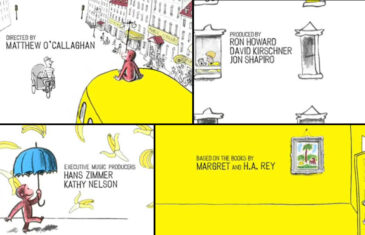
Curious George is a traditionally-animated film adaptation of the children’s stories by H.A. and Margret Rey. It was released in the United States on February 10, 2006.
Matthew O’Callaghan directed (after replacing Jun Falkenstein). This project had been in development hell at Imagine Entertainment for a long time, dating back at least as long ago as 1992 (and possibly many years before this).
The screenplay was written by Michael McCullers, Daniel Gerson, Rob Baird, Joe Stillman and Karey Kirkpatrick. Although it is a traditionally-animated film, about twenty percent of it takes place in 3D environments that were computer-generated. This was Universal’s first theatrically-released feature-length animated film since 1995′s Balto. It was Imagine Entertainment’s first animated film.