By Joseph Tabbi
Was Saul Bass a writer? Was he a poet? Given that his film title ‘texts’ are not ‘his’ – not his compositions in the accepted sense, what is his art and how can it be seen as a writer’s art, a literal art? N. Katherine Hayles, an important theorist of writing in new media, suggests that the materiality of any text, emerges as a dance between the medium’s physical characteristics and the work’s signifying strategies (personal communication). Saul Bass does this dance with words. We need, says Hayles, to follow the dance when we read and write because our moves require a ‘ media specific ’ analysis of language art. The physical characteristics of the media that both deliver and constitute writing are in flux, and writers are using novel or re-emergent signifying strategies to generate their meanings as literal art.Personal email communication with John Cayley. Here is a published formulation: ”The materiality of an embodied text is the interaction of its physical characteristics with its signifying strategies.” N. Katherine Hayles. My Mother Was a Computer: Digital Subjects and Literary Texts. Chicago: University of Chicago Press, 2005, p. 103 (emphasis in original). The work of Saul Bass re-emerges, and can be shown to underlie the so-called new.
Words move. The graphic bodies of language – from letters to words, from phrases to entire texts – translate, scale, and morph on our private and public screens in a bewildering and so-far uncatalogued array of transitions. As readers, we are more and more habituated to such literal dynamism, a kinetic textuality that is hard to square with capital-l Literature’s notions of the copy-text, the edition, the authorized textual event – all those institutionally published forms of words that transform the writer into a ‘person of letters’ – and, for example, allow her to generate royalties from licensing what has legal-magically become an enclosed property.
When did words begin to move? This question pulls me back – from a familiar, if utopic and theoretical, ‘new textuality’ rant – to the work of Saul Bass, to a history of practice. Written words first moved on film. Film titling, in particular, is where we must look for a self-conscious and aestheticized practice of dynamic typography and, indeed, of dynamic writing. This work predates the small body of video-based language work (Richard Kostelanetz), the few but significant essays of art language practitioners (Jenny Holtzer), and also, of course, what writing there is that exists in programmable media. Given that time-based, dynamic writing is here to stay, on screen or wherever it next migrates, its largely unacknowledged and little-analysed early history – in media that support its time-based properties – deserves far greater attention. And not only for a history of the form and its aesthetics – readers like you and I are now, for example, increasingly subject to advertising’s appropriation of ‘type in motion.’ To my mind, there has been a recent marked increase in high-end ads with sophisticated dynamic textuality. We need tools for its critical reading.
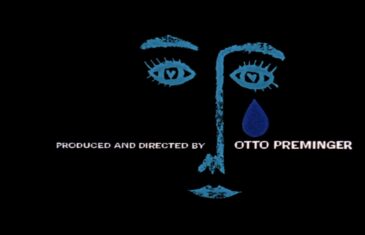
The major exposition of Saul Bass’s graphic and film title work at London’s Design Museum was, therefore, essential. Saul Bass was the first film title designer to be given a screen credit by the Director’s Guild of America (for Preminger’s Carmen Jones 1954) and remains an all but uniquely name-checkable artist in the film titles field. Yet his fame derives equally if not in greater measure from his related, more purely graphic work, where he is a central figure in that late-50s, early-60s school of jazz-rhythmic, cool, flat, monochromatic design, with a clever use of abstraction that allowed for significant interaction between normally distinct representational modes: paper cut-out silhouettes become body parts, become an assembled corpse, become (once more) a potential and actual surface for writing (see his titles for Anatomy of a Murder 1959, with the process I’ve just described encapsulated in the film’s famous posters). Many visitors to the exhibition will have gone there simply to revisit one source of a perennially hip graphic style.

Anatomy of a Murder, 1959 (Director: Otto Preminger; Design: Saul Bass; (c) AMPAS)
Nonetheless the film title work is crucial. Certain aspects of the style I’ve characterised are also vital to the dynamic writing of Bass’s most important titles. Specifically, we must try to understand the distinct ways in which Bass plays with abstraction; how they carry over from his graphic work and become, as it were, played out and dramatised in his time-based titling. Bass uses abstraction in a manner that recalls Scott McCloud’s brilliant sketch of the subject in Understanding Comics . For McCloud, the disjuncture between visual abstraction and written language is a creative problem. He suggests a continuum from the extremes of graphic abstraction to conventional signs of writing. The folk etymologies of pictorial word-signs (early letter-forms, hieroglyphics, Chinese characters) lend their evocative history to a range of suggestive procedures. Don’t get me wrong. I’m not (and neither is McCloud) a theoretical naive, or wedded to an orientalist hallucination of ideography. The disjuncture between language and graphics remains clear. The two practices are materially distinct because their signifying strategies and physical characteristics are radically different. Nonetheless, suggestive links are links, and such links may signify. They can do more than this. They can constitute a rhetoric and materiality of their own, a trans-medial art practice.
Like McCloud’s ‘invisible art,’ graphic design, particularly typographic design, is a trans-medial art par excellence, part of an engaged project which strives to make the visual and sub-linguistic aspects of writing signify. Graphic design proceeds to set out writing’s ‘paratextual’ properties – conventional and creative aspects of writing’s layout and framing – and render them not only aesthetically but substantively meaningful. How else can the performances of typography be appreciated? What need of typographers otherwise? Saul Bass, through the reality of the once-new technology of film and its illusion of animation, gave us the first literal performances of this necessary and vital interplay between language-as-visual-form and language-as-symbolic-representation. He animated the bodies of words along with their paratextual demons and familiars.
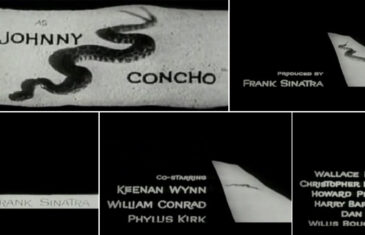
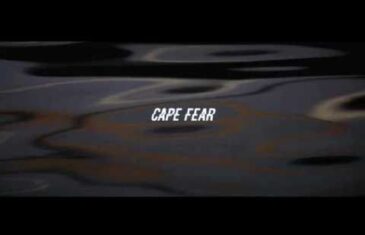
Bass achieved this during the second half of the 1950s, in his groundbreaking titles for films from The Man with the Golden Arm (1955) through Psycho (1960), and, to a certain extent, Spartacus (1960). The latter marks a distinct shift in his practice, after which, in the 1960s and 1970s, he turned away from film titling and worked more directly with the visual imaginary of cinema, as then understood. Spartacus uses photorealist images of objects – especially a bronze bust – but shot such that they hover on the edge of the silhouette-abstraction that had become a Bass trademark. From Spartacus on, the actual words of his titles are distinct typographic forms floating over or through the visual imaginary that they caption. In Spartacus, a letter-edge might still have caught on the edge of a silhouette. By contrast, none of the words in the titles for Cape Fear (1991) would share a surface with the water and shadow over which they move.
This more familiar, later work – in what has become the establish mode of film titling – sets the innovations of Bass’s 1950s work in sharp relief. The typographic ‘rule’ – typically a printed bar of ink – was an important trans-medial element in his film titles of the time. Rules are quintessentially paratextual. They share the surface of writing and they share its graphic materiality – particularly contrasting monochrome colour. They manage and marshal the spaces in which writing is set, but they are not writing in the strict sense of symbolic representation. At one and same time, rules are also lines, lines that may shape themselves into abstract visual representations.

The Man with the Golden Arm, 1955 – two versions (Director: Otto Preminger; Design: Saul Bass; (c) AMPAS)
Titles for The Man with the Golden Arm demonstrate this perfectly. A single heavy rule sweeps down to mark the director’s credit; three more are propagated and, while introducing the names of the (three) lead actors, suggest, to my eye, walking legs. Three of the four vanish leaving one upper rule, with the three now returning, sweeping in from the other screen edges, to set out the superbly composed spaces of the film’s title. The same rules go on to marshal and punctuate the remaining credits, suggesting more visual forms and spaces, and also, I would argue, letter forms, before finally and infamously combining to become the jagged silhouette of the ‘golden arm’ itself.
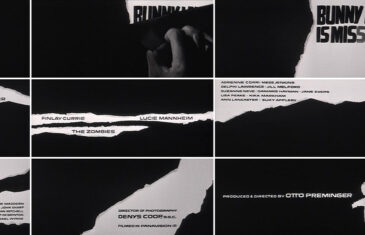
Rules in Bass’s work do not typically become letters, but they do interfere with the surfaces of writing – sometimes making the switch from foreground to background and becoming a newly delineated surface of inscription. This is shown, for example, if we consider the torn-out surface spaces of Bunny Lake is Missing as in some sense a special type of rule. Rules can also interfere directly with writing, which provides a reading of the titles for Psycho where they become manic and overwhelming, slicing through the caption words, momentarily allowing us to glimpse and read, before destroying legibility in a striated frenzy that is permanently linked with cinema’s most notorious shocker.
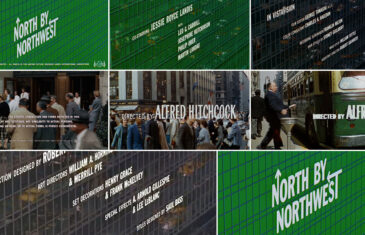
Bass’s masterpiece is the title sequence for North by Northwest (1959) where rules are present in their primary role as the squared lines supporting text. But more, in this sequence, their formation of a (archi)textual gridwork also provides a direct link to the visual imaginary, to a world of real images, a prefiguration of Bass’s personal concerns with cinema per se and also, I’d argue, an unconscious premonitory graphic representation not only of the interaction of the symbolic and the real but of the information-age virtual and the real. These titles are a ‘central processor’ of writing in new media, before its time had come.


These images of North by Northwest have been taken from notcoming.com
The sequence opens with a landscape-aspect grid receding in perspective, not yet quite recognizable as the surface of a modernist office block. Words of the titles glide in on the gridlines and, in particular, glide up and down the vertical lines where they meet and come momentarily to rest for reading. As they do so, their movements are suddenly like those of elevators in a building, giving us one of the first visual clues to a real-world referent for the abstract grid as a signifier or representation.
This resemblance of the words’ movements to elevators marks a relatively uncharacteristic evocation of Concrete poetics – bodies of words behave like objects. Words in Bass’s Goodfellas (1990) titles imitate coke-accelerated cars, but I can’t think of other prominent examples. In fact, his work is remarkable for its avoidance of Concrete. Paratextual elements, like rules, are allowed to crossover, via abstraction, into the visual, but words remain set in legibility, as tokens of the symbolic. The important thing in Bass’s titles is the continuum that is played out in literal time-based art, a continuum of rhetorical possibilities and signifying strategies that cross and recross from visual to linguistic media and back, in evocative iterative performance, without ever loosing a grip on their specific materialities.
The ruled gridlines of North by Northwest are faithful to graphics, typography, visuality, and text all at once. As the sequence progresses this becomes clear. The words of the title perform their function – we can simply read the credits – and give material pleasure in their design and movement. At a certain point the grid moves away from abstraction and is filled in with the mirrored glass windows of a modernist office block. It becomes real or rather more than real because it is a also mirror, a surface that is one particular privileged representation of the world. We see people and traffic alive and moving in the mirror-world and world of filmic naturalism. Meanwhile, the title words continue to share this same surface. They are still well-set and respectful of typographic principles but now they share a surface of visual representation that is simultaneously a real object (the building) in the (film) world. It’s a tour de force. These titles embody a continuum of signifying strategies across media that could only be performed in time.
The potential for the now familiar screenic surface of programmable media as a site of a literal trans-medial art is discovered in the titles for North by Northwest . It’s as simple and as richly suggestive as that. Where do we go from here? In his work on West Side Story(1961) Bass quietly and wittily played with real surfaces as a site for (title) writing, with the credits expressed as graffiti and intermixed with signage. One of the recognized artists in contemporary film titles, Kyle Cooper, literally etched the credits for Se7en (1995) onto film stock. Some suggestions: We continue to write with a Bass-resonant reverential materialism, with respect for the surfaces on which we make our inscriptions. We move writing from surface to surface, from media to media, with this same respect, not only from the pseudo-transparent surface of print to the screen or the virtual surfaces of artistic performance, but onto real surfaces. We do this writing in real and in human time.
*This essay has also appeared in Mute: Culture and Politics After the Net , Winter/Spring 2005 Issue 29.
McCloud, Scott. Understanding Comics: The Invisible Art. Kitchen Sink Press, 1993. New York: HarperPerennial, 1994.
http://www.electronicbookreview.com/thread/electropoetics/dynamic
by Noell Wolfgram Evans
A night at the movies once went like this: you’d arrive at the theatre, see a short subject, a cartoon, a smaller (B) movie and then the main feature would dance across the screen followed by a slate of coming attractions.
Over time and for a variety of reasons this bill shifted and changed until we arrived at the movie night of today: arrive at the theatre, see a commercial, a couple of previews, the main picture and go home. With the hectic pace of today’s life, no one really complains about theatre’s dropping the first feature and the absence of a short subject is all but forgotten but having no cartoon, that’s on a different level. The majority of filmgoers wouldn’t mind seven minutes of color before the main feature. Unfortunately, the advent of television and the rising cost of animation, combined with other factors and contributed to the ‘demise’ of the animated short theatrical feature. Or did it?
Looking back and viewing the landscape of film exhibition, particularly in regards to animation, it is reasonable to see that animated shorts have not in fact disappeared from the silver screen, rather they evolved into an integral part of the main feature. Today when going to the movies, chances are that animation will be a part of the bill, most likely as the main feature titles.
In the days of silent film, the story was moved along by title cards, which were imbued with text and inserted through out the action. The white lettering on black backgrounds was sometimes livened up by some decorative additions (such as ‘lace’ outlines, type treatments or drawings of characters or buildings) but for the most part, they were rather plain. The cards could be found not just within the film, but before as well. And so film titles were born, dull and plain, but they were here. Thankfully they evolved and matured to where they were not just reciting off the names of the films participants, but were actually an integral part of the main feature. This maturation of the film titles was due in large part to one man: Saul Bass.
Saul Bass was one of the first to seize on the potential storytelling power of the opening and closing credits of a film. He used a number of styles (animation, live action, type treatments) to create credits for films as diverse as Casino (1995) and It’s a Mad, Mad, Mad, Mad World (1963). What he created were opening credit sequences that did not simply announce the credits and open the movie, they were instead a logical extension of the film. Each sequence was in it’s self a short film that prepared the viewer for what was to come. In his closing credit sequences, he worked to give the story a ‘semi-prologue’, to give the viewer a chance to continue the experience of the film while bringing it to a close.
Saul was born in New York City on May 8, 1920. He was interested in art from an early age and did all that he could to expand his passions. At the age of 15, he began taking painting classes at the Art Student’s League in Manhattan. He studied here until he was old enough to attend Brooklyn College. His stay here, under the tutelage of Gyorgy Kepes, would be the turning point in his life and work. He was deeply influenced in his studies on the Modernist School of Design and what he learned would have a hold on all that he did for the next fifty years. Following graduation, he worked his way around a number of New York advertising agencies before moving to Los Angeles in 1948.
Saul began his time in Hollywood doing print work for film ads. After a brief bit of time he found his job expanding and in 1954 he was asked to design and create a title sequence to the film Carmen Jones. Bass saw this as an opportunity to enhance the filmgoers experience. He didn’t want to just have his sequence inform the audience, nor did he want to use the time to do some fancy graphical work that would show of his talents but add nothing to the film.
Saul Bass:
“My initial thoughts about what a title can do was to set mood and
the prime underlying core of the film’s story, to express the story
in some metaphorical way. I saw the title as a way of conditioning
the audience, so that when the film actually began, viewers would
already have an emotional resonance with it”1
As Bass went forward, he proceeded in perfecting these thoughts, creating mini-narratives which would help bring the viewer into the film.
Writer Ken Coupland feels that in this respect, Bass is something of a magician:
“I believe that a great title sequence almost literally hypnotizes
you, especially the work of Saul Bass where there’s a very strong
repetitive swirling motion and abstract things that happen that’s
putting you into a dream-like state.”2
This is especially true in Bass’ work for Alfred Hitchcock on the titles for Vertigo (1958) and North by Northwest (1958). In the latter film, Bass used animated lines working behind the credits to create a maze like feel. He ensnared each name while using the animation to foreshadow Cary Grant’s plight. Perhaps the real trick comes at the end of the sequence, when the lines ‘become’ the skyscraper in the films opening.
Some of Bass’s early title work is very ‘graphic design-centric’ but as he went on, he moved away from that center, using a number of mediums, particularly animation. His work on two pictures in particular shows his knowledge and understanding of animation including it’s effects and influences on it’s audience and it’s surroundings (here the feature that followed/proceeded it).
Anatomy of a Murder (1959)
One of 11 films that Bass worked on with Otto Preminger, this may constitute his best work in the collaboration. Inspired by the animated interludes that John Hubley created for The Four Poster (1952), Bass used limited animation playing over a jazz soundtrack (created specifically for the film by Duke Ellington) to bring the viewer into the film’s world of murder and betrayal. The entire sequence is based on the ‘ad’ for the film: a silhouette of a corpse, broken into pieces. It looks like a puzzle, where all of the pieces are close to being snapped together but just not quite there. This piece is the central image in the two minute opening animated title sequence.
Bass opens with the image as a whole and then it quickly disappears from view. We are then presented with the separate pieces of the body which slide on and off the screen in a cool and smooth manner as Ellington’s music walks us through. Sometimes the image moves quickly on and off and sometimes it arrives on screen and stays passive for a moment only to suddenly shatter apart.
The sequence perfectly sets the viewer up: by using only parts of the body, and in no certain order, one is left wondering what will come next and, like the puzzle pieces that they are, how each relates to the other. Just when things start to make sense, an image on screen shatters, effectively telling the viewer that nothing is solid, nothing is what it seems. It all works together to bring the viewer into the proper frame of mind for the mystery that follows. All of this is underscored beautifully by Bass’s decision to use a limited style of animation. The ‘jumpiness’ of the medium, helps keep the viewer jarred and on their toes, they were not allowed to simply waltz into this movie relaxed, they would instead enter the film as participants.
Bass’ work here is all the more impressive when it is viewed against another equally strong, but completely different sequence.
Around the World in 80 Days (1956)
This Michael Anderson directed film (which won the Academy Award for Best Picture) is one of those three-hour Hollywood blockbusters filled with nearly every star of the day. In this extravaganza, Bass’ work appears not at the beginning of the film, but at the end. The six-minute cartoon that he created to display the end credits gave people a reason to stay in the theatre even after ‘The End’ flashed across the screen.
For his work, Bass used fully realized animated figures against a plain background to retell the story of the film. In this short our hero is a clock on legs. Starting in London, the clock begins its journey around the world; this is done not literally but through the use of symbols (pyramids for Egypt, Elephants for India). An interesting twist that Bass added was not to scroll the credits across the screen but to integrate them into the movement. When the clock reaches the American West, a saloon door swings open and behind it is the name of one of the players in that scene. The door swings closed and another opens, revealing another name. In Paris, the names appear as fireworks blasts that illuminate the city. (While tricks like this may seem old hat today, remember that the majority of the films at this time used plain, static text for their credits.)
Bass plays all of his action off of Victor Youngs jaunty score to produce a completely realized animated version of the essence of the film. The credits here don’t just rehash the story material, but rather present it for us in a new way and it really is only after witnessing it that you feel as if the film is truly completed.
Saul Bass’ talents stretched into many areas. For film, besides creating title sequences for others’ movies, he also Produced and Directed several of his own short features. In 1968 he won an Academy Award for his partially animated short film Why Man Creates. He continued to work in film up until his death on April 25, 1996. He left an incredible body of work that still influences filmmakers and continues to hold movie watchers in amazement. He has been celebrated in exhibitions both ‘static’ (at New York City’s School of Visual Arts) and ‘moving’ (a number of film exhibitions travel the country now celebrating the art of the film title). His name even adorns an award that is given annually to the film with the best title sequence. Mr. Bass’ greatest legacy though may be that in a time when others were removing animation from theatres, he helped not only to keep it there, but to make it an essential part of a night at the movies.
1. Film Quarterly. Fall 1996
2. creativeloafing.com September 2000
–
Noell Wolfgram Evans is a freelance writer who lives in Columbus, Ohio. He has written for the Internet, print and had several plays produced. He enjoys the study of animation and laughs over cartoons with his wife and daughter.
Demonstrating they are smarter than the average design/production studio, yU+co. crafted a glorious stereoscopic 3D main-on-end title sequence for the new Warner Bros animated film Yogi Bear. Led by Synderela Peng, Art Director on the design and Richard Taylor, VFX Director on the production, and Producer Sarah Coatts, the team created a sequence that cleverly incorporates stylistic elements of Saul Bass with the madcap nature of Hanna-Barbera’s animation to create something truly its own.