by Noell Wolfgram Evans
A night at the movies once went like this: you’d arrive at the theatre, see a short subject, a cartoon, a smaller (B) movie and then the main feature would dance across the screen followed by a slate of coming attractions.
Over time and for a variety of reasons this bill shifted and changed until we arrived at the movie night of today: arrive at the theatre, see a commercial, a couple of previews, the main picture and go home. With the hectic pace of today’s life, no one really complains about theatre’s dropping the first feature and the absence of a short subject is all but forgotten but having no cartoon, that’s on a different level. The majority of filmgoers wouldn’t mind seven minutes of color before the main feature. Unfortunately, the advent of television and the rising cost of animation, combined with other factors and contributed to the ‘demise’ of the animated short theatrical feature. Or did it?
Looking back and viewing the landscape of film exhibition, particularly in regards to animation, it is reasonable to see that animated shorts have not in fact disappeared from the silver screen, rather they evolved into an integral part of the main feature. Today when going to the movies, chances are that animation will be a part of the bill, most likely as the main feature titles.
In the days of silent film, the story was moved along by title cards, which were imbued with text and inserted through out the action. The white lettering on black backgrounds was sometimes livened up by some decorative additions (such as ‘lace’ outlines, type treatments or drawings of characters or buildings) but for the most part, they were rather plain. The cards could be found not just within the film, but before as well. And so film titles were born, dull and plain, but they were here. Thankfully they evolved and matured to where they were not just reciting off the names of the films participants, but were actually an integral part of the main feature. This maturation of the film titles was due in large part to one man: Saul Bass.
Saul Bass was one of the first to seize on the potential storytelling power of the opening and closing credits of a film. He used a number of styles (animation, live action, type treatments) to create credits for films as diverse as Casino (1995) and It’s a Mad, Mad, Mad, Mad World (1963). What he created were opening credit sequences that did not simply announce the credits and open the movie, they were instead a logical extension of the film. Each sequence was in it’s self a short film that prepared the viewer for what was to come. In his closing credit sequences, he worked to give the story a ‘semi-prologue’, to give the viewer a chance to continue the experience of the film while bringing it to a close.
Saul was born in New York City on May 8, 1920. He was interested in art from an early age and did all that he could to expand his passions. At the age of 15, he began taking painting classes at the Art Student’s League in Manhattan. He studied here until he was old enough to attend Brooklyn College. His stay here, under the tutelage of Gyorgy Kepes, would be the turning point in his life and work. He was deeply influenced in his studies on the Modernist School of Design and what he learned would have a hold on all that he did for the next fifty years. Following graduation, he worked his way around a number of New York advertising agencies before moving to Los Angeles in 1948.
Saul began his time in Hollywood doing print work for film ads. After a brief bit of time he found his job expanding and in 1954 he was asked to design and create a title sequence to the film Carmen Jones. Bass saw this as an opportunity to enhance the filmgoers experience. He didn’t want to just have his sequence inform the audience, nor did he want to use the time to do some fancy graphical work that would show of his talents but add nothing to the film.
Saul Bass:
“My initial thoughts about what a title can do was to set mood and
the prime underlying core of the film’s story, to express the story
in some metaphorical way. I saw the title as a way of conditioning
the audience, so that when the film actually began, viewers would
already have an emotional resonance with it”1
As Bass went forward, he proceeded in perfecting these thoughts, creating mini-narratives which would help bring the viewer into the film.
Writer Ken Coupland feels that in this respect, Bass is something of a magician:
“I believe that a great title sequence almost literally hypnotizes
you, especially the work of Saul Bass where there’s a very strong
repetitive swirling motion and abstract things that happen that’s
putting you into a dream-like state.”2
This is especially true in Bass’ work for Alfred Hitchcock on the titles for Vertigo (1958) and North by Northwest (1958). In the latter film, Bass used animated lines working behind the credits to create a maze like feel. He ensnared each name while using the animation to foreshadow Cary Grant’s plight. Perhaps the real trick comes at the end of the sequence, when the lines ‘become’ the skyscraper in the films opening.
Some of Bass’s early title work is very ‘graphic design-centric’ but as he went on, he moved away from that center, using a number of mediums, particularly animation. His work on two pictures in particular shows his knowledge and understanding of animation including it’s effects and influences on it’s audience and it’s surroundings (here the feature that followed/proceeded it).
Anatomy of a Murder (1959)
One of 11 films that Bass worked on with Otto Preminger, this may constitute his best work in the collaboration. Inspired by the animated interludes that John Hubley created for The Four Poster (1952), Bass used limited animation playing over a jazz soundtrack (created specifically for the film by Duke Ellington) to bring the viewer into the film’s world of murder and betrayal. The entire sequence is based on the ‘ad’ for the film: a silhouette of a corpse, broken into pieces. It looks like a puzzle, where all of the pieces are close to being snapped together but just not quite there. This piece is the central image in the two minute opening animated title sequence.
Bass opens with the image as a whole and then it quickly disappears from view. We are then presented with the separate pieces of the body which slide on and off the screen in a cool and smooth manner as Ellington’s music walks us through. Sometimes the image moves quickly on and off and sometimes it arrives on screen and stays passive for a moment only to suddenly shatter apart.
The sequence perfectly sets the viewer up: by using only parts of the body, and in no certain order, one is left wondering what will come next and, like the puzzle pieces that they are, how each relates to the other. Just when things start to make sense, an image on screen shatters, effectively telling the viewer that nothing is solid, nothing is what it seems. It all works together to bring the viewer into the proper frame of mind for the mystery that follows. All of this is underscored beautifully by Bass’s decision to use a limited style of animation. The ‘jumpiness’ of the medium, helps keep the viewer jarred and on their toes, they were not allowed to simply waltz into this movie relaxed, they would instead enter the film as participants.
Bass’ work here is all the more impressive when it is viewed against another equally strong, but completely different sequence.
Around the World in 80 Days (1956)
This Michael Anderson directed film (which won the Academy Award for Best Picture) is one of those three-hour Hollywood blockbusters filled with nearly every star of the day. In this extravaganza, Bass’ work appears not at the beginning of the film, but at the end. The six-minute cartoon that he created to display the end credits gave people a reason to stay in the theatre even after ‘The End’ flashed across the screen.
For his work, Bass used fully realized animated figures against a plain background to retell the story of the film. In this short our hero is a clock on legs. Starting in London, the clock begins its journey around the world; this is done not literally but through the use of symbols (pyramids for Egypt, Elephants for India). An interesting twist that Bass added was not to scroll the credits across the screen but to integrate them into the movement. When the clock reaches the American West, a saloon door swings open and behind it is the name of one of the players in that scene. The door swings closed and another opens, revealing another name. In Paris, the names appear as fireworks blasts that illuminate the city. (While tricks like this may seem old hat today, remember that the majority of the films at this time used plain, static text for their credits.)
Bass plays all of his action off of Victor Youngs jaunty score to produce a completely realized animated version of the essence of the film. The credits here don’t just rehash the story material, but rather present it for us in a new way and it really is only after witnessing it that you feel as if the film is truly completed.
Saul Bass’ talents stretched into many areas. For film, besides creating title sequences for others’ movies, he also Produced and Directed several of his own short features. In 1968 he won an Academy Award for his partially animated short film Why Man Creates. He continued to work in film up until his death on April 25, 1996. He left an incredible body of work that still influences filmmakers and continues to hold movie watchers in amazement. He has been celebrated in exhibitions both ‘static’ (at New York City’s School of Visual Arts) and ‘moving’ (a number of film exhibitions travel the country now celebrating the art of the film title). His name even adorns an award that is given annually to the film with the best title sequence. Mr. Bass’ greatest legacy though may be that in a time when others were removing animation from theatres, he helped not only to keep it there, but to make it an essential part of a night at the movies.
1. Film Quarterly. Fall 1996
2. creativeloafing.com September 2000
–
Noell Wolfgram Evans is a freelance writer who lives in Columbus, Ohio. He has written for the Internet, print and had several plays produced. He enjoys the study of animation and laughs over cartoons with his wife and daughter.
“The opening credits of American Horror Story set the tone for what is becoming the strangest and most thrilling fifty minutes of television each week. As an ear piercing low industrial bass scratches along in the background, the viewer is treated to a quickly cut montage of photos of dead babies, body parts in jars and bloodshed. As the main titles roll, and the final wail of the bass resonates in ones ears, they cannot help but be taken to a place that brings them great uncertainty and discomfort.”
DOUGLAS K. BARCLAY, THE TOWER
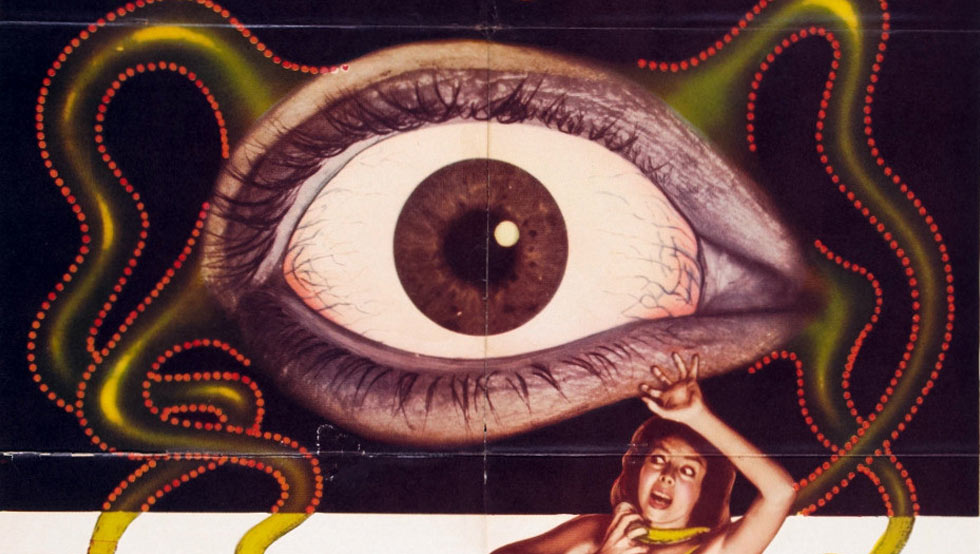
The Trollenberg Terror is the title of both a 1956 “Saturday Serial” ITV UK television programme and a better-known 1958 black and white science fiction film.
The latter is also known as The Crawling Eye, Creature from Another World, The Creeping Eye, and The Flying Eye. Both versions are directed by Quentin Lawrence and feature Laurence Payne as journalist Philip Truscott, who investigates unusual accidents occurring at a Swiss resort. The film also stars Forrest Tucker as United Nations troubleshooter Alan Brooks.
Peter Key wrote the story for the serial, and Jimmy Sangster scripted the film version based on Keys’s story. It was the final film to be produced by Southall Studios, one of the earliest pioneer film studios in the UK.
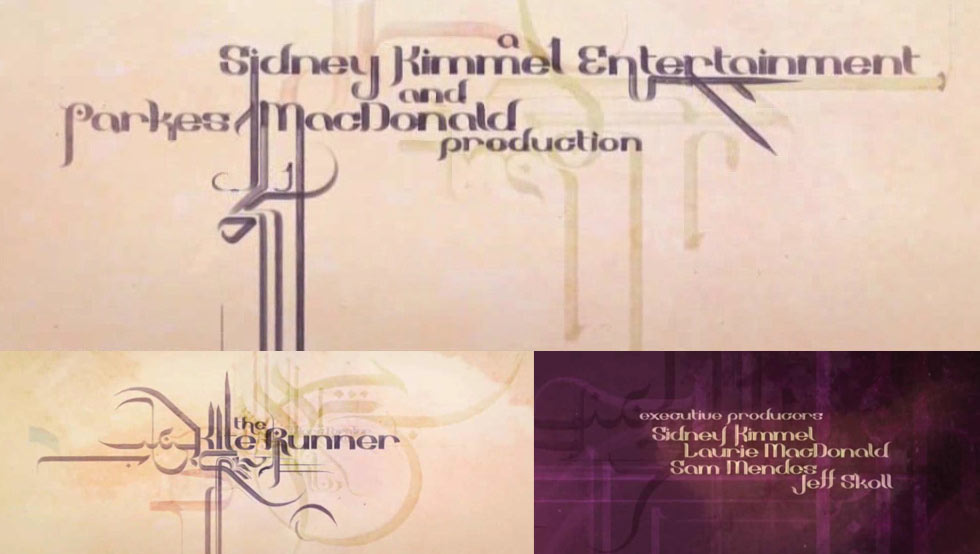
The Kite Runner is a 2007 film directed by Marc Forster based on the novel of the same name by Khaled Hosseini. It tells the story of Amir, a well-to-do boy from the Wazir Akbar Khan district of Kabul, who is tormented by the guilt of abandoning his friend Hassan, the son of his father’s Hazara servant.
The story is set against a backdrop of tumultuous events, from the fall of the monarchy in Afghanistan through the Soviet invasion, the mass exodus of refugees to Pakistan and the United States, and the Taliban regime.
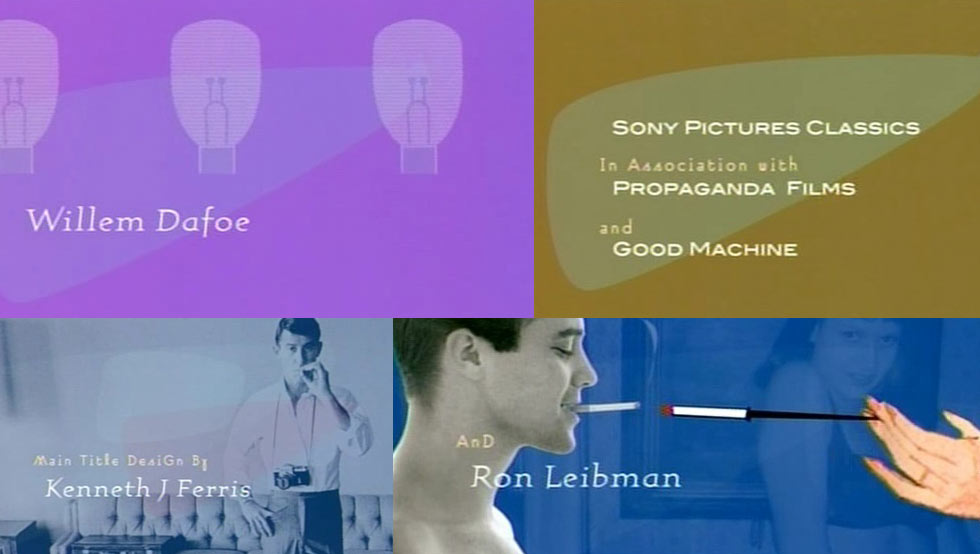
Starring: Greg Kinnear, Willem Dafoe, Rita Wilson, Maria Bello
Director: Paul Schrader
Paul Schrader’s film, Autofocus, is the story of Bob Crane (played by Greg Kinnear), who had the title character in the hit TV series, “Hogan’s Heroes” in the late 1960′s. The interesting thing about the real-life story of Bob Crane is the fact that he was brutally murdered in 1978 by a killer who was never convicted, even though everyone knew who it was. The movie examines how fame and fortune in Hollywood can turn someone’s life upside down – in this case, by over-feeding a man’s sex-obsession to the point of self-destruction.
By EMILY OBERMAN AND BONNIE SIEGLER
Published: February 21, 2009 New York Times
There’s an Oscar for pretty much every aspect of filmmaking, except one: the title sequences. Titles, though, have always played a significant part in motion pictures. They may have started out as simple black-and-white cards. But in the days before sound, they already did more than identify key players: they communicated dialogue and advanced plot. And as filmmaking evolved, so did title design. Titles have become wonderful bridges from reality into the cinematic world and back out again. At their very best, they are themselves innovative, emotional experiences, microcosms of their movies. Here are some highlights from the history of title sequences:
“The Palm Beach Story,” designer unknown, 1942. This hilarious sequence, full of freeze-frames and set to a mash-up of “Here Comes the Bride” and “The William Tell Overture,” shows the romantic leads beset by strange disasters on their way to the altar. It’s remarkable because it contains all the clues to unlock the screwball comedy’s twist ending.
“Psycho,” Saul Bass, 1960. The graphic slicing through the credits is an abstract representation of the horrors to come. Bernard Herrmann’s score mimics and enhances this violent effect. Like the movie, the title sequence is frightening in its minimalism.
“To Kill a Mockingbird,” Stephen Frankfurt, 1962. The slow pan over the jumbled contents of the cigar box — a man’s pocket watch, crayons, some marbles — lets you inside the minds of the film’s child characters. The modern typography offers a perfect contrast.
“The Pink Panther,” Friz Freleng and David DePatie, 1963. As a stand-alone cartoon starring the Pink Panther, the character created for this sequence, these titles are a perfect tip-off to the silliness that follows. Of course, Henry Mancini also provides one of cinema’s most memorable scores.
“Dr. Strangelove,” Pablo Ferro, 1964. The title sequence that inspired a thousand hand-drawn title sequences. With an orchestral version of “Try a Little Tenderness” playing, this footage of one jet refueling another in mid-air is delicately, beautifully sexual and creepy.
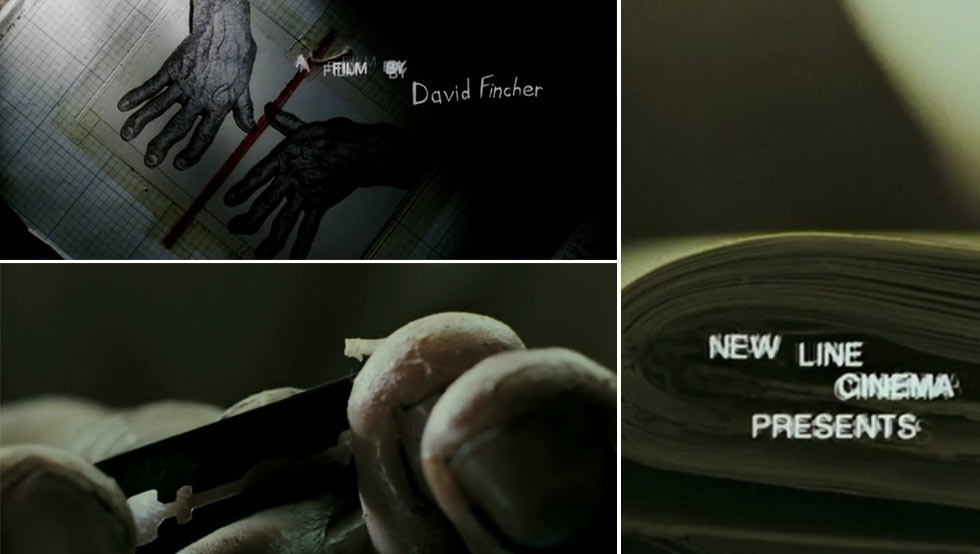
“Seven,” Kyle Cooper, 1995. These titles offer our first glimpse of the movie’s mysterious serial killer — his writings and possessions, his terrifying preparations. The type seems scratched on the celluloid by the killer himself. This sequence is almost as scary as the movie.
IT’S hard to imagine why these and the other exceptional title sequences have never been recognized by the Oscars. We would like to urge the academy to create this much-needed category. In the meantime, we’ve gone ahead and selected the title sequences that should have been nominated for 2008. During the nomination process, we happened upon an interesting trend: filmmakers, more and more, are plunging viewers right into the action and then ending with elaborate title sequences, which serve as epilogues or bonus tracks. Without further ado — or a badly scripted joke — our nominees for Best Achievement in Film Title Design:
1. “WALL-E,” Susan Bradley and Jim Capobianco/Pixar. These poignant end titles, which show humans and robots flourishing on a revived Earth, offer a quick history of art, from cave paintings to van Gogh. They then proceed to retell the entire movie, this time in the pixelated style of old video games.
2. “Tropic Thunder,” Kyle Cooper/Prologue. These titles feature Tom Cruise’s best performance in years as he dances to “Get Back” by Ludacris. They’re intercut with graphic freeze-frames of the rest of the cast.
3. “Slumdog Millionaire,” Matt Curtis. Another dance sequence, this one in grand Bollywood style. After a film full of difficult and sad struggles, this joyous, cathartic sequence, set to “Jai Ho” by A. R. Rahman, gives us hope that the main characters will actually live happily ever after.
4. “Iron Man,” Danny Yount/Prologue. Amazing in a comic-book way, these take us inside the blueprints for Tony Stark’s armor. The soundtrack, appropriately, unavoidably, is “Iron Man” by Black Sabbath.
5. “Mamma Mia!,” Matt Curtis. The end titles toss off the pretense of winding a story around the songs and give us a straight-up, super-’70s tribute, complete with glitzy rainbow prism effects and Meryl Streep singing her heart out.
Emily Oberman and Bonnie Siegler are the co-founders of Number Seventeen NYC, a design firm.
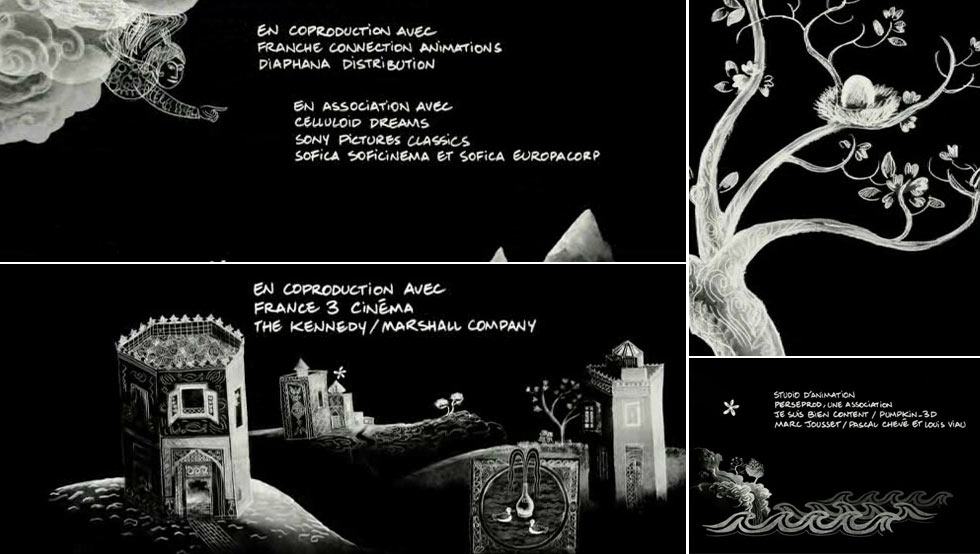
Persepolis is a 2007 animated film based on Marjane Satrapi’s autobiographical graphic novel of the same name. The film was written and directed by Satrapi with Vincent Paronnaud.
The story follows a young girl as she comes of age against the backdrop of the Iranian Revolution. The story ends with Marjane as a 21-year-old expatriate. The title is a reference to the historic city of Persepolis.
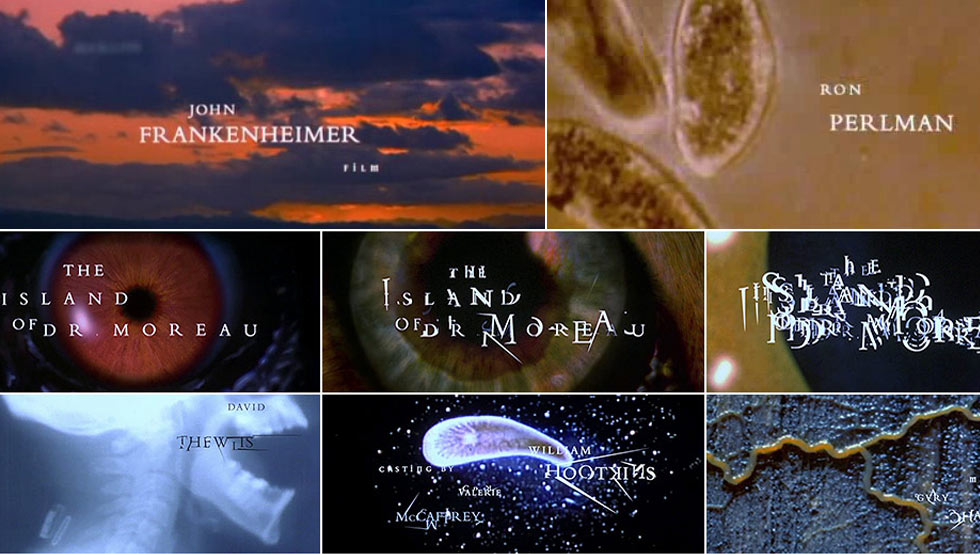
The Island of Dr. Moreau is a 1996 film, the third major movie version of the H. G. Wells novel The Island of Doctor Moreau, a science fiction horror story about a scientist who attempts to convert animals into people. The film stars Marlon Brando, features Val Kilmer, Fairuza Balk, David Thewlis and Ron Perlman, and was directed by John Frankenheimer. The screenplay was written by Richard Stanley and Ron Hutchinson.
Seven (also marketed as SE7EN) is an American 1995 Academy Award, BAFTA nominated crime film directed by David Fincher and written by Andrew Kevin Walker. The story follows two detectives, one retiring (Morgan Freeman) and one his replacement (Brad Pitt), jointly investigating a series of ritualistic murders inspired by the seven deadly sins.