Via eyemagazine.com
Title sequences of the 1950s and ’60s grabbed moviegoers with psychological insights, orchestral violence and some lessons learnt from the early pioneers of animation, for whom motion graphics, sound and story were inseparable. By Joel Karamath
Title sequences have reached an unprecedented level of attention, with vast numbers of design studios dedicated to television and cinema motion graphics. Yet the history of the contemporary title sequence stretches back a generation or more, when Saul Bass and Maurice Binder laid the foundations for the modern form, and even earlier, to the short cartoon films of the 1920s and ’30s.
Bass’s titles for director Otto Preminger’s Carmen Jones (1954) and The Man with the Golden Arm (1955) emerged at a time when popular music was consolidating its position as the dominant art form of the twentieth century. The musical impact of both films reflects the zeitgeist of the post-war era that marked the advent of commercial television and advertising – the engine room of consumer society in the us. Television advertising, like the title sequence and the radio ad before it, was defined by music. Yet the influence music had in shaping visual culture on the screen predates this golden age of consumerism.
Sound had always been a goal for mainstream cinema: even in the days of the silent era, sound was unavoidable, complementing and enlivening the screen action via a cinema pianist or, occasionally, a full orchestra. Warner Brothers’ first “talkie” The Jazz Singer in 1927, was a famous success, but it could be argued that the first truly successful marriage of sound and image came with the animated shorts produced soon afterwards, and typically shown as part of the exhibition programmes (feature, b-movie, newsreel, cartoons) to which audiences flocked at that time. One only need look at the names the studios gave their productions to see their debt to music: Merry Melodies, Happy Harmonies, Loony Toons, Silly Symphonies.
Max Fleischer, MGM, Disney and Warner Bros relied heavily upon music for the structure of their short cartoons. Disney’s first major success Steamboat Willie (1928) was Mickey Mouse’s debut in a skit that derives much of its humour from the surreal visualisation of musical cues. In one instance Mickey turns the tail of a goat to the accompaniment of a barrel organ, while in another he plays a cow’s teeth to the sound of a xylophone. When he pulls the string of the boat’s whistle, the instrument forms a mouth and blows.
The most prominent use of music as a catalyst for character and plot visualisation stemmed from Warner Bros, one of the most productive studios (known as “Termite Terrace”), with a huge staff that included some of the greatest animators of all time. Throughout the studio’s heyday in the 1930s, 1940s and early 1950 the prime focus point for artists such as Jones, Avery, Freleng and Clampett would often stem from the sound department, where specialist Mel Blanc created the voices for Bugs, Daffy, Porky et al, and composer Carl Stalling (who had previously worked for Disney on Steamboat Willie) scored the music. While Blanc largely delivered voiceover dialogue and jokes to a script, Stalling was engaged at all stages of production: the interaction between his music, producers such as Leon Schlesinger and animators such as Chuck Jones resulted in a unique body of collaborative work.
The avant-garde films of that time were produced by visual artists who treated the new medium of film as an extension of their respective disciplines: artists such as Man Ray, Ferdnand Léger, Dudley Murphy and Len Lye worked to existing music or silence. Stalling and, similarly, Scott Bradley, head of music at mgm, had helped to create something that was, like the Bollywood musical and the pop promo today, much more than film with musical interludes. It was a specific form, just as grand opera is distinct from opera, or pantomime from dramatic theatre; something that Hollywood would not begin to amend, with the shift from non-integrated to integrated musicals, for over a decade. Further still, these cartoons were products in which the music was both non-diegetic score and diegetic sound effect at the same time, compounding their innovative uniqueness.
Through its publishing division, Warner Bros had an extensive music catalogue, affording the animation studio access to some of the most popular tunes of the day. So it was also the first to seize upon the opportunity of promoting its records visually. The sight of Tom (of Tom and Jerry) crooning Louis Jordan’s “Is You Is Or Is You Ain’t My Baby” marks a marketing strategy that predates MTV by decades. The immediate artistic and commercial success of the animated short in integrating sound, vision and movement supports historian Eric Hobsbawn’s assertion that with the “failure of modernism” advertising and cinema became the true avant-garde.
Stalling retired in 1956 just as television was beginning to usurp the big screen. As genres such as the newsreel and the short moved to the small screen, animation suffered a drastic drop in funding. The elaborate music arrangements of Stalling and Bradley, hitherto scored individually for each production, were replaced by cheaper generic mood pieces, sterile melodies dropped in behind impoverished visuals.
THE START OF A FRANCHISE
As television heralded the demise of quality mainstream animation, cinema began to find a new outlet for the amalgamation it had spawned: the title sequence, which set the mood and provided audiences with a taste of the narrative to come. For the movie-going audience, the title sequence filled a gap left, after the demise of the old exhibition package, by the absence of newsreels and animated shorts.
The way in which this symbiosis between title sequence, score and story can be used to establish motif and character traits is exemplified by the James Bond series (nearly twenty “official” Bond films), started by Dr. No (1962). The Bond title sequence and theme tune are two of the most instantly recognisable cinematic signatures. Despite the obvious impact and lasting impression of Binder’s work, the highly complex mixing and layering of his sequence for Dr. No almost renders the Modernist ethos of his mentor, Saul Bass, redundant: it foreshadows a postmodern tendency to mix and match.
The congested complexity of the Dr. No titles is simplified on subsequent films in the Bond series by separating the original sequence pattern into two individual entities. The opening sequences for From Russia With Love and Goldfinger separate two musically led graphic segments with an opening action scene (unrelated to the movie’s plot) that reduces the harsh juxtaposition of competing graphic images and music of Dr. No . The use of very specific title songs in the Bond movies, as with Goldfinger, also created a separate (and marketable) product.
THE COLLABORATIVE AUTEUR
The postwar period saw a marked shift in film scoring, when composers such as Elmer Bernstein and Bernard Herrmann began to develop a dramatic style that Bernstein described as a move towards a more “emotional . . . inner psychological state”, which relied not so much upon a series of themes as “creating atmosphere”, often without resolution. The brutal violin shrieks of Herrmann’s score for Psycho stand out as one of the most memorable sounds in the history of cinema. Herrmann began his film career with Orson Welles’s Citizen Kane (1941) and died shortly after completing Scorsese’s Taxi Driver (1976). At the hub of an exemplary career in the movies was his eleven-year, eight-film partnership with Alfred Hitchcock. Herrmann’s conception of cinema was an interpretation based upon the balance between sound and image: “The moment that you do a story on film, music becomes almost imperative . . . It is in the nature of cinema that it needs music, theatre doesn’t need music really.”
Herrmann’s statement certainly rings true in relation to the role of the title sequence and is best shown by his work with Saul Bass for Hitchcock, at the end of the 1950s. The collaboration between the three men, though short-lived, was extremely fruitful. Hitchcock is often spoken of as the auteur’s auteur and while there is no doubting his influence on everything he touched, it is equally important to acknowledge the contributions of his regular production crew: Robert Burks’ cinematography, George Tomasini’s editing and the costumes of Edith Head. As much as anything else, Hitchcock’s genius lay in his ability to relay his messages to and through others, most specifically through the work of Bass and Herrmann.
Their first film titles together, Vertigo (1958), provide a perfect example of Hitchcock’s communicative powers, with Bass and Herrmann working separately through the director, Herrmann later scoring to Bass’s visuals. The final construction, like the movie itself, is a slow-moving and uncannily evocative piece that transcends the sum of its melodramatic and repetitive parts.
Vertigo, often considered Hitchcock’s finest work, was quickly followed a year later by North by Northwest, another thriller based upon identity, though not nearly as dark or brooding as Vertigo. Cary Grant’s lead makes play with a witty and romantic script by Ernest Lehman. Bass, Herrmann and Hitchcock conjure an opening score and title sequence that work as a mini-prologue to the film, engaging the audience with related plot themes from the outset. Herrmann’s score is simple and to the point, reflecting the juxtaposition of humour and suspense in the movie with a mixture of high and low notes (flutes to timpani) that represent the opposing forces at work in the film. It has a lighter tone than his score for Vertigo, including a “Gershwin-esque” homage to New York where the film starts, and an exhilarating theme for the chase that covers half of the us.
Bass’s titles are equally engaged with the plot through the use of an animated grid: the names of the stars and production staff follow each other vertically on and off the screen in a game of cat and mouse, prefiguring the precarious positions in which the main characters find themselves. A final twist comes when the grid fades into a shot of a skyscraper, its windows reflecting the street below, a distorted vision of an everyday scene that primes us for a tale of mistaken identity.
VIOLENT HORIZONTALS
Vertigo may be Hitchcock’s most critically acclaimed work and North By Northwest one of the most entertaining but Psycho (1960) is his most notorious, ushering in a new era of film-making and spawning the “slasher movie”. Made on a low budget, in black and white without major stars, it is one of the most influential and imitated ever. Despite several radical changes in production methods, he hired Bernard Herrmann as composer and Saul Bass for the titles. (Bass is also credited as “pictorial consultant”.) Psycho has a special place in twentieth century culture, honoured by several “sequels” with the late Anthony Perkins, a much-derided scene-for-scene 1998 remake (in colour!) by Gus Van Sant and an installation by artist Douglas Gordon, whose 24-hour Psycho clicks slowly through each frame of the original movie.
The film’s content is anticipated in the opening title sequence by the violent music (a string chamber orchestra that Herrmann chose to reflect John L. Russell’s monochrome cinematography) and the slices made in the block capitals of the director’s name, closely followed by the pattern made by slicing a series of vertical bars.
The pinnacle of Bass and Herrmann’s collaboration with Hitchcock would come with one of the most memorable scenes in movie history. The condensed montage of shots in the shower scene – which took the best part of a week to film, placing the camera in over 70 positions – is on screen for little over a minute. It was storyboarded, shot and edited by Bass, who also had to persuade Hitchcock to include Herrmann’s score: the director had originally intended to screen the scene without music (see extract on p41). Less than halfway through the movie, they created a cinematic climax that has never been bettered.
ALL THE ANIMALS COME OUT AT NIGHT
Psycho marked the apex and the conclusion of the collaboration between Hitchcock, Bass and Herrmann: the three were never to work as a team again. Bass and Hitchcock (whom Bass said had “taught him the art of film-making”), would fall out, some say over their differences on Psycho. Hitchcock’s next picture, The Birds (1963), featured a title sequence by James Block and electronic music by Oskar Sala. (Herrmann acted as a consultant.) A few years later he would be removed from his position as the composer on Torn Curtain (1966) by Hitchcock, never to work with the director again. All three continued to produce good work, but never quite reached the symbiosis of their work on Vertigo, North by Northwest and Psycho. Bass went on to produce two of his most outstanding creations, Walk on the Wild Side (1962) and Nine Hours to Rama (1963), soon after the split from Hitchcock, yet these movies highlight the pitfalls of working outside the confines of a tight team. Both sequences are superbly crafted entities (working with scores by, respectively, Elmer Bernstein and Malcolm Arnold) that work as separate narrative interpretations and represent their films’ stories in miniature. Yet Bass’s titles are considered by some critics to be more memorable than the films.
Herrmann’s final score for Taxi Driver symbolises the gothic sleaze of mid-1970s New York. Without overtly graphic titles, the saxophone-led cues intensify the glaring montage of traffic signals, street signs, cinemas, theatres and storefronts in Manhattan, while the more orchestral passages glance back to the emotional turmoil of Scottie in Vertigo. The parallel nature of Herrmann’s work to Bass and Hitchcock on Vertigo was best summarised in reference to a composition made over twenty years later. When Martin Scorsese was asked about the importance of Herrmann’s score for Taxi Driver, he said: “It provided the psychological basis throughout . . . a vortex that never comes to completion. Just when you think it’s finished it starts all over again.”
Both Bass and Herrmann worked best with visionary auteurs brave enough to let them interact with their work on a intellectual, physical and emotional level, enabling them to create work that not only complemented but raised the films on which they collaborated to new levels of emotional richness.
Dr No
Title sequence from Dr. No, 1962. Design: Maurice Binder. Music: John Barry and Monty Norman. Animation: Trevor Bond. Director: Terence Young. Producers: Harry Saltzman, Albert R. Broccoli. © 1962 Danjaq, LLC and United Artists Corporation.
In Dr. No Maurice Binder sows the seeds for what was to become the classic Bond opening: a white circle appears on the screen, to the accompaniment of primitive electronic music – simple bleeps like test tones. The circle manifests itself as the spiral of a gun barrel (or the iris of a lens) in which “Bond” is focused. He beats his would-be assassin to the draw and with a single shot turns the screen red. This screen fills with flashing multicoloured dots (animated by Trevor Bond) that finally form the title of the film and serve as an accompaniment for the main actors’ credits. The third segment of the titles introduce the cavorting silhouettes of go-go dancers that later became a Bond hallmark. Here they are intended to evoke the “exotic” Caribbean, where the film is set, and London in the swinging 1960s. There is then a dissolve to the fourth and final segment as the dancers fade into the silhouettes of three “blind” men loping across the screen from left to right, which in turn dissolve into the live footage of the same three characters, soon to be revealed as vicious assassins, as the story begins.
The four sections of Binder’s opening are paralleled by four distinct soundtrack segments. In the first part, Binder’s dot logo is seen accompanied by high-pitched electronic test tones (which, like the dot, establishes a link between Bond, the film and the onset of the computer age). A gun shot then ignites the dot-matrix spectacular, introducing the title of the film, in the second segment, along with Monty Norman’s Bond theme, arranged by the hastily recruited John Barry with its long, chromatic string line and twanging guitar. Stage three uses an exotic bongo rhythm for the dancing figures, which then develops into a calypso version of “Three Blind Mice”, a tentative first use of the Bond device of using a theme song linked to the story (“Diamonds Are Forever”, “The World Is Not Enough”).
Goldfinger
Title sequence from Goldfinger, 1964. Design: Robert Brownjohn. Music: John Barry. Director: Guy Hamilton. Producers: Harry Saltzman, Albert R. Broccoli. © 1964 Danjaq, LLC and United Artists Corporation.
By the time of Goldfinger, which had a budget at least five times that of Dr. No, the James Bond title formula was firmly established. The short opening iris segment is largely copied from Dr. No, except that it dispenses with the electronic bleeps and uses the John Barry version of the Bond theme throughout. A four-minute plus action scene follows that establishes Bond’s credentials as a resourceful spy and “ladykiller” – glimpsing a would-be assailant in a lover’s eye in mid-clinch, he spins round so that the girl takes the blow.
The pre-credit sequence works as a mini-Bond movie that re-establishes the 007 persona for fans and provides a swift introduction for newcomers. Robert Brownjohn’s credit sequence shows scenes from the movie projected on to a woman’s golden-painted body (the villain’s nubile assistant is sadistically murdered by “epidermal asphyxiation” early in the plot) to the accompaniment of Barry’s theme song, with lyrics by Anthony Newley and Leslie Bricusse sung by Shirley Bassey. This was the first Bond movie to feature a full-blown song over the titles – From Russia With Love uses an instrumental version of the theme song. Goldfinger could be seen as the first complete Bond sequence, as well as the aesthetic pinnacle of the franchise, setting a template for the series that, though often imitated, has rarely been surpassed.
Vertigo
Title sequence from Vertigo, 1958. Design: Saul Bass. Music: Bernard Herrmann. Director: Alfred Hitchcock. © Universal Studios.
In Vertigo, the acrophobic protagonist Scottie (James Stewart) obsessively recreates Madeleine, for whose suicide he feels responsible, in the person of the living Judy (Kim Novak). Bernard Herrmann scored the “Prologue” music to Bass’s visuals, constructing an uncannily evocative piece that far outweighs the sum of its parts. Indicative of what David Toop described as the “intellectual” impact of images and text in relation to the “emotional” content of music, the sequence manages to convey issues inherent in this slow, complex film through simple means.
As the studio logo fades we hear a harp initiate a repetitive melody which is taken up by the violins. Bass’s images enter at a point where low strings have just introduced a sense of foreboding. Bass crops Novak’s face tightly, employing what film-maker Barney Cokeliss described as a “cinematic blazon”, a technique later deployed to great effect by Scorsese at the start of Taxi Driver, when Travis Bickle (Robert De Niro) is introduced through the window and rearview mirror of his taxi. With his Vertigo titles, Bass suggests the notion of a constructed woman, giving us fragments rather than a whole. Herrmann’s melody continues, but is interrupted by a Wagnerian surge of horns, as credits for the lead actors, director and title appear, before returning to its melancholic cycle.
Appropriately enough for a film about image and identity, the title appears over a full frame of Novak’s eye. As we are drawn into the centre of her iris a small, animated vortex begins to spiral and grow until it engulfs the whole screen, undergoing a series of colour changes. This spiralling icon, coupled with the repeating melody, provides a theme that runs throughout the movie: that of revisiting and re-inventing the past. The spiral represents Scottie’s vertigo, the coil of hair on a woman’s head in an oil portrait, a bouquet of flowers and the winding wooden staircase of the bell tower from which Madeleine falls to her death. Bass’s colour changes for this graphic are equally significant. The icon first appears in Novak’s eye tinted red before trawling through the spectrum, a cue to the importance Hitchcock gives to colour throughout the movie as Scottie, the ultimate fall guy, is sucked into an emotional void.
Psycho
Title sequence from Psycho, 1960. Design: Saul Bass. Music: Bernard Herrmann. Director: Alfred Hitchcock. © Shamley Productions.
Psycho will always stand as one of Hitchcock’s masterpieces but there can be few of his films which have had such a direct, creative input from outside sources. Without Herrmann’s score, Psycho would be something completely different, something less, while Bass picks up all the themes that are established in the opening credits, right through to the midpoint climax of the movie. Paul Hirsch commented that “the extreme emotional duress is due entirely to the music”. What we see is not just heightened by the music – it is taken to another level. The shrieking violins are the externalisation of Norman Bates’s internal angst. Hitchcock’s brief to the composer, for a light jazz score, was thankfully ignored.
As with Vertigo and North By Northwest the score sets up a repetitive momentum that keeps bringing us back to the same place over and over again, but unlike the two previous films, there is no genuine respite. The introduction is abrupt and jumps in almost with a climax; everything about the score is an attack. The repetition does not take us around in a circle but is a constant onslaught, wave after wave that cannot be resisted. Visually, the violence to come is relayed in the opening sequence by horizontal slashes that rip through the pure white titles and credits on screen. As in The Man With The Golden Arm, solid white bars appear but they offer little defence from this attack. The Powers of Ten-style zoom into the doomed heroine’s bedroom window implies that this is just one of many stories in this particular naked city.
First published in Eye no. 39 vol. 10, 2001
by Noell Wolfgram Evans
A night at the movies once went like this: you’d arrive at the theatre, see a short subject, a cartoon, a smaller (B) movie and then the main feature would dance across the screen followed by a slate of coming attractions.
Over time and for a variety of reasons this bill shifted and changed until we arrived at the movie night of today: arrive at the theatre, see a commercial, a couple of previews, the main picture and go home. With the hectic pace of today’s life, no one really complains about theatre’s dropping the first feature and the absence of a short subject is all but forgotten but having no cartoon, that’s on a different level. The majority of filmgoers wouldn’t mind seven minutes of color before the main feature. Unfortunately, the advent of television and the rising cost of animation, combined with other factors and contributed to the ‘demise’ of the animated short theatrical feature. Or did it?
Looking back and viewing the landscape of film exhibition, particularly in regards to animation, it is reasonable to see that animated shorts have not in fact disappeared from the silver screen, rather they evolved into an integral part of the main feature. Today when going to the movies, chances are that animation will be a part of the bill, most likely as the main feature titles.
In the days of silent film, the story was moved along by title cards, which were imbued with text and inserted through out the action. The white lettering on black backgrounds was sometimes livened up by some decorative additions (such as ‘lace’ outlines, type treatments or drawings of characters or buildings) but for the most part, they were rather plain. The cards could be found not just within the film, but before as well. And so film titles were born, dull and plain, but they were here. Thankfully they evolved and matured to where they were not just reciting off the names of the films participants, but were actually an integral part of the main feature. This maturation of the film titles was due in large part to one man: Saul Bass.
Saul Bass was one of the first to seize on the potential storytelling power of the opening and closing credits of a film. He used a number of styles (animation, live action, type treatments) to create credits for films as diverse as Casino (1995) and It’s a Mad, Mad, Mad, Mad World (1963). What he created were opening credit sequences that did not simply announce the credits and open the movie, they were instead a logical extension of the film. Each sequence was in it’s self a short film that prepared the viewer for what was to come. In his closing credit sequences, he worked to give the story a ‘semi-prologue’, to give the viewer a chance to continue the experience of the film while bringing it to a close.
Saul was born in New York City on May 8, 1920. He was interested in art from an early age and did all that he could to expand his passions. At the age of 15, he began taking painting classes at the Art Student’s League in Manhattan. He studied here until he was old enough to attend Brooklyn College. His stay here, under the tutelage of Gyorgy Kepes, would be the turning point in his life and work. He was deeply influenced in his studies on the Modernist School of Design and what he learned would have a hold on all that he did for the next fifty years. Following graduation, he worked his way around a number of New York advertising agencies before moving to Los Angeles in 1948.
Saul began his time in Hollywood doing print work for film ads. After a brief bit of time he found his job expanding and in 1954 he was asked to design and create a title sequence to the film Carmen Jones. Bass saw this as an opportunity to enhance the filmgoers experience. He didn’t want to just have his sequence inform the audience, nor did he want to use the time to do some fancy graphical work that would show of his talents but add nothing to the film.
Saul Bass:
“My initial thoughts about what a title can do was to set mood and
the prime underlying core of the film’s story, to express the story
in some metaphorical way. I saw the title as a way of conditioning
the audience, so that when the film actually began, viewers would
already have an emotional resonance with it”1
As Bass went forward, he proceeded in perfecting these thoughts, creating mini-narratives which would help bring the viewer into the film.
Writer Ken Coupland feels that in this respect, Bass is something of a magician:
“I believe that a great title sequence almost literally hypnotizes
you, especially the work of Saul Bass where there’s a very strong
repetitive swirling motion and abstract things that happen that’s
putting you into a dream-like state.”2
This is especially true in Bass’ work for Alfred Hitchcock on the titles for Vertigo (1958) and North by Northwest (1958). In the latter film, Bass used animated lines working behind the credits to create a maze like feel. He ensnared each name while using the animation to foreshadow Cary Grant’s plight. Perhaps the real trick comes at the end of the sequence, when the lines ‘become’ the skyscraper in the films opening.
Some of Bass’s early title work is very ‘graphic design-centric’ but as he went on, he moved away from that center, using a number of mediums, particularly animation. His work on two pictures in particular shows his knowledge and understanding of animation including it’s effects and influences on it’s audience and it’s surroundings (here the feature that followed/proceeded it).
Anatomy of a Murder (1959)
One of 11 films that Bass worked on with Otto Preminger, this may constitute his best work in the collaboration. Inspired by the animated interludes that John Hubley created for The Four Poster (1952), Bass used limited animation playing over a jazz soundtrack (created specifically for the film by Duke Ellington) to bring the viewer into the film’s world of murder and betrayal. The entire sequence is based on the ‘ad’ for the film: a silhouette of a corpse, broken into pieces. It looks like a puzzle, where all of the pieces are close to being snapped together but just not quite there. This piece is the central image in the two minute opening animated title sequence.
Bass opens with the image as a whole and then it quickly disappears from view. We are then presented with the separate pieces of the body which slide on and off the screen in a cool and smooth manner as Ellington’s music walks us through. Sometimes the image moves quickly on and off and sometimes it arrives on screen and stays passive for a moment only to suddenly shatter apart.
The sequence perfectly sets the viewer up: by using only parts of the body, and in no certain order, one is left wondering what will come next and, like the puzzle pieces that they are, how each relates to the other. Just when things start to make sense, an image on screen shatters, effectively telling the viewer that nothing is solid, nothing is what it seems. It all works together to bring the viewer into the proper frame of mind for the mystery that follows. All of this is underscored beautifully by Bass’s decision to use a limited style of animation. The ‘jumpiness’ of the medium, helps keep the viewer jarred and on their toes, they were not allowed to simply waltz into this movie relaxed, they would instead enter the film as participants.
Bass’ work here is all the more impressive when it is viewed against another equally strong, but completely different sequence.
Around the World in 80 Days (1956)
This Michael Anderson directed film (which won the Academy Award for Best Picture) is one of those three-hour Hollywood blockbusters filled with nearly every star of the day. In this extravaganza, Bass’ work appears not at the beginning of the film, but at the end. The six-minute cartoon that he created to display the end credits gave people a reason to stay in the theatre even after ‘The End’ flashed across the screen.
For his work, Bass used fully realized animated figures against a plain background to retell the story of the film. In this short our hero is a clock on legs. Starting in London, the clock begins its journey around the world; this is done not literally but through the use of symbols (pyramids for Egypt, Elephants for India). An interesting twist that Bass added was not to scroll the credits across the screen but to integrate them into the movement. When the clock reaches the American West, a saloon door swings open and behind it is the name of one of the players in that scene. The door swings closed and another opens, revealing another name. In Paris, the names appear as fireworks blasts that illuminate the city. (While tricks like this may seem old hat today, remember that the majority of the films at this time used plain, static text for their credits.)
Bass plays all of his action off of Victor Youngs jaunty score to produce a completely realized animated version of the essence of the film. The credits here don’t just rehash the story material, but rather present it for us in a new way and it really is only after witnessing it that you feel as if the film is truly completed.
Saul Bass’ talents stretched into many areas. For film, besides creating title sequences for others’ movies, he also Produced and Directed several of his own short features. In 1968 he won an Academy Award for his partially animated short film Why Man Creates. He continued to work in film up until his death on April 25, 1996. He left an incredible body of work that still influences filmmakers and continues to hold movie watchers in amazement. He has been celebrated in exhibitions both ‘static’ (at New York City’s School of Visual Arts) and ‘moving’ (a number of film exhibitions travel the country now celebrating the art of the film title). His name even adorns an award that is given annually to the film with the best title sequence. Mr. Bass’ greatest legacy though may be that in a time when others were removing animation from theatres, he helped not only to keep it there, but to make it an essential part of a night at the movies.
1. Film Quarterly. Fall 1996
2. creativeloafing.com September 2000
–
Noell Wolfgram Evans is a freelance writer who lives in Columbus, Ohio. He has written for the Internet, print and had several plays produced. He enjoys the study of animation and laughs over cartoons with his wife and daughter.
“Motion Plus Design” is a non-profit project which aims to create the first exhibition center dedicated to Motion Design in Paris, France. Students, professionals and anyone interested can discover artists, meet them and learn a thing or two. This centre will also provide an opportunity to promote artists in other design departments so the different graphic design worlds could cross.
“Motion design is already present in all parts of our lives. Yet, no place is dedicated to celebrating motion design. When we realised this, we came up with the idea of founding the world’s first Centre dedicated to the world of motion design.”
The video below has for goal promoting this interesting idea and takes a look at the growth of Motion Design throughout the century:
“Motion Plus Design” – the first exhibition center dedicated to Motion Design in Paris!
Posted by motionVFX Team
January 30, 2012, at 10:54 PM
“Motion Plus Design” is a non-profit project which aims to create the first exhibition center dedicated to Motion Design in Paris, France. Students, professionals and anyone interested can discover artists, meet them and learn a thing or two. This centre will also provide an opportunity to promote artists in other design departments so the different graphic design worlds could cross.
“Motion design is already present in all parts of our lives. Yet, no place is dedicated to celebrating motion design. When we realised this, we came up with the idea of founding the world’s first Centre dedicated to the world of motion design.”
The video below has for goal promoting this interesting idea and takes a look at the growth of Motion Design throughout the century:
Every month the centre will welcome (infomation via official website):
either an artist [Kyle Cooper for example, the current American king of title sequences]
or a production company team [Post Panic or Psyop for ex.]
or a theme [for example 'the history of motion design from the 1920s to the present day']
The Centre will also house an area exclusively dedicated to the showing of work by experimental artists, from photographers, video artists and / or interactive and / or typographical artists. The idea is to create interaction between two worlds: those who are interested in Motion Design will be surprised to discover the exhibition of the work of a photographer, and those who will come to look at the work of a typographer will discover Motion Design.
Source: http://motion-plus-design.com
Find the common element among these things: Psycho; United Airlines; Quaker Oats; Dixie Cups; Goodfellas; the Girls Scouts of America. I picked a grab bag, and I could have included a lot more, to show how diverse the work of Saul Bass was; he did graphics, and more, for all of them. There is no bigger name in graphic design than Saul Bass, and now there is a gorgeous book, huge and colorful as befits his career, Saul Bass: A Life in Film and Design (Lawrence King Publishing) by his daughter Jennifer Bass, herself a graphic designer, and Pat Kirkham, who teaches decorative arts and design history. Flip through the 400 big pages here, and you are bound to find logos, posters, and movie title sequences you have seen many times; Bass’s range and influence were astonishing. There is a bit of biography here, along with a relatively chronological summary of his work from his poster for his high school’s open house through the poster for Schindler’s List. The text is worth reading, and the authors have quoted generously from Bass’s own thoughts on his life, work, methods, and output. As befits Bass’s legacy, however, this is a picture book, and it is a treat for the eyes.
Bass was born in the East Bronx in 1920, the child of Jewish immigrants. Late in life he recalled, “Some years ago I was asked, ‘When you were a kid what did you want to be when you grew up?’ Back then I thought the answer I gave was funny. I said, ‘Saul Bass.’ It was no joke.” He was Saul Bass early; besides excelling in art in high school, he painted signs for local fruit stalls and store windows. A scout for the Art Students League saw some of the signs, found out who made them, and offered Bass a scholarship. He took fine arts courses, but knew what sort of work he wanted to do. “The layout class had a fine-art content, but Saul was happy with the approach, realizing that to be any good at commercial art he had to learn such things as form, color, perspective, and composition.” His first job was for a small commercial art studio that designed trade ads for United Artists; it was just the work he wanted, although film ads in those days had none of the associations with glamour that was to come. “I had no idea anyone looked down upon advertising,” he said. “I looked up to it.” Still, he grew tired of following formulas and “cramming as much illustration, type and hype as you possibly could into ads.” When he took the next job as an art director, he specified that he would not work on movie ads.
Bass was introduced to the Bauhaus theorist György Kepes, who became his mentor and helped change Bass’s work into the strongly Modernist mode, paring away decoration and superfluities. Bass’s firm had trouble with its account for Warner Brothers, and despite his “no movies” stance, Bass was back working on films. In 1946 he realized he had to get out to Hollywood. Movies were changing, not only reflecting the social conditions of the postwar years, but also more films were being made by independent directors and producers. Title sequences of the movies were conventional letters over conventional backgrounds, and sometimes theaters ran the initial credits over the curtain as it went up. Bass thought a film began at the first frame and deserved a mood-setting overture. His title sequences are famous for setting the tone of the film, and are among the best ever made, from the swirling Lissajous patterns of Vertigo to the funny cartoons preceding It’s a Mad, Mad, Mad, Mad World.
Bass also did the credits for Psycho, and Hitchcock knew how important integrating Bass’s work into the film was. “Hitchcock involved Saul from the earliest stage. They had meetings before writing began, and Saul received each section of the screenplay as it was completed.” The result was a series of black and white bars on the screen, shifting as if you could almost figure out why, and revealing the words of the credits only when they came infrequently into perfect alignment. It was a signal of dysfunction and uncertainty. Not only did Bass do the titles, he was paid a good fee to “do something” with the shower murder scene, one of the most famous and frightening sequences in all cinema. Bass came up with storyboards that emphasized quick cutting to show a bloody murder in a stylized, frenzied fashion. Hitchcock was reluctant: “I showed it to Hitch. It was very un-Hitchcockian in character. He never used that kind of quick cutting; he loved the long shot.” Bass was even on the set and Hitchcock let him take charge of the filming of the sequence, but Hitchcock when interviewed by François Truffaut six years later was evasive about giving Bass credit.
Bass (and his wife Elaine, who gets much credit in this book for their joint efforts) had a “fade out” from making movie titles. He had a lot of corporate work to do, and was making his own documentaries and film essays (he also directed one feature film, Phase IV). He also found that directors were newly interested in using the title sequence themselves creatively, and perhaps this was a response to his own work. Nonetheless, he came back in the 1990s, working for among others Martin Scorsese (who writes the book’s forward), for whom he did the admirable credits for Goodfellas, Cape Fear, The Age of Innocence, and Casino. Quentin Tarantino gives an interesting analysis of this sort of work, saying that Bass was the greatest of title sequence makers. “I could never do what Scorsese does – give up control of the opening of my film to someone else, not even Saul Bass – I guess I should say Saul and Elaine Bass. I need to keep control of everything and Scorsese is too great a filmmaker not to know the importance of control. It can only mean one thing: Scorsese must have absolute, ab-so-lute, confidence in them. And that is nothing less than amazing to me.”
Among the most interesting pages here are the reproductions of preparatory sketches leading to a final product. Bass would do perhaps 300 sketches for a single simple logo. Shown here are his preparatory drawings for Otto Preminger’s Advise & Consent. The sketches include a Capitol dome with a wind up key, or a faceless congressman with a key in his back, or congressmen as puppets on strings. These are all good. The one Bass and Preminger agreed upon, however, was brilliant, showing the dome of the Capitol tilted open, as if the movie is going to “rip the lid off” the way politics is done. Some of the pictures here show Bass getting ready to make a presentation of his logo work to a particular corporation – there are hundreds of alternative designs on the walls. Bass was a master of the presentation of the final design to corporate clients; he liked being “on stage,” had excellent comedic timing and wit, and connected with each client individually. The presentation was the culmination of intensive work, starting with an analysis of what the company had done, its competitors, and its communication materials, and even enlisting market research. It is significant that Bass thought that one of the most interesting parts of his work was the interviews with one executive at a time. “I get to ask powerful and often interesting people about their work and their lives. It is in their heads that the real blueprint for the future exists or is being formed.”
Bass was devoted to progressive causes, and did plenty of pro bono work; there are designs here for the ACLU, the Special Olympics, Boys Clubs, YWCA, and more. Bass had a devoted family, and people who worked for his firm remembered a dynamic, funny, intense man who loved his job. When they split off to make their own firms, he gave them his blessing – it was part of the creative process, and he had done the same thing himself. To see the many designs in this book is to appreciate that while his work was too diverse to have any one unifying esthetic, it was characterized by simplicity, distillation, and minimalism, and was always forceful because it was so concentrated. Revealingly, he was anxious with every new assignment; he told young designers that “the only difference experience made, he believed, was the knowledge that since one had managed to come up with good ideas in the past, there was good reason to believe it would happen again.” He also said that considering present work is humbling “because no matter how much experience you have, the blank page is still terrifying.” Maybe so, but he conquered any such fears countless times, with successes reproduced here on page after page of memorable, effective images.
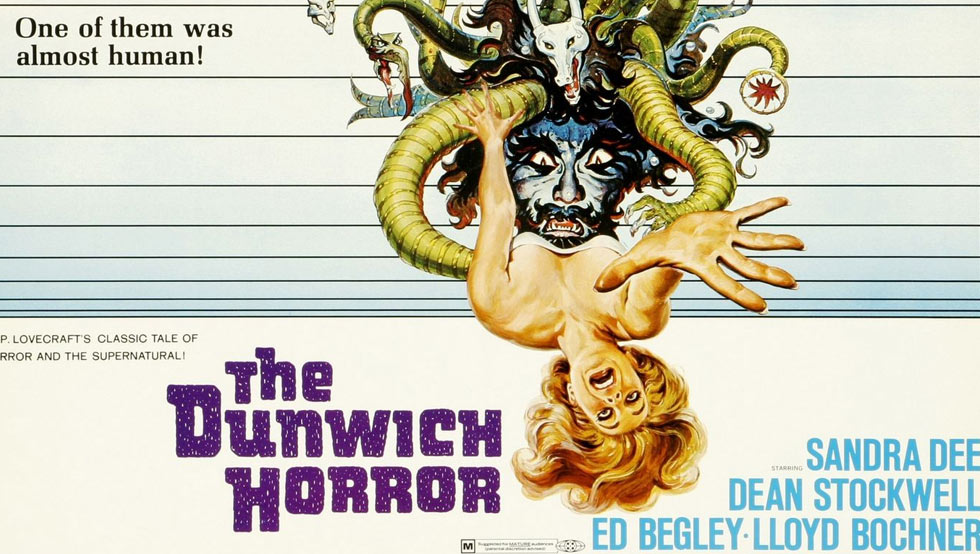
The Dunwich Horror is a 1970 B-movie from American International Pictures directed by Daniel Haller and produced by Roger Corman. The film was based on the short story of the same name by H.P. Lovecraft with a script co-written by future Academy Award winning director Curtis Hanson.
Sandy Dvore is an American artist and graphic designer.Dvore first became well-known for designing the cover art for Buffalo Springfield’s eponymous album. He is best known for his work in designing television’s more iconic title sequences, such as the walking partridges in The Partridge Family, and the brush-stroke logo and paintings from the long-running soap opera The Young and the Restless.
His film title credits include the 1976 film Lipstick and the 1972 Blaxploitation thriller Blacula. Also, he designed the opening credits for selected seasons of the nighttime soap opera Knots Landing.Dvore’s close friend is producer and director Bob Claver, who convinced Screen Gems to hire him to do the opener for The Partridge Family as well as other subsequent shows.
Dvore’s work in graphic design won him an Emmy Award in 1987 for “Carol, Carl, Whoopi and Robin”.
New York, New York, March 24, 2011 – Creative Studio Trollbäck + Company launched its digital division early March to expand its experience design capabilities and provide integrated digital solutions and interactive media for advertising / branding campaigns and public space installations.
Making the decision to expand into digital was strategic yet organic, considering Trollbäck + Company has worked over the past ten years extensively within the commercial, network and entertainment industries. Executive Creative Director Jakob Trollbäck states, “Our work has always been about creating experiences. For us, it was natural to venture into more immersive, engaging projects that are both emotional and intellectual.”
After a successful run at his award-winning agency, Red Antenna, Digital Creative Director, Stephen Baker joins Trollbäck + Company to helm the T+Co Digital Division. With a background in both design and programming, Steve has the cross-discipline perspective to develop highly visual interactive experiences. His work with clients such as American Express, Sony, VH1 and Nokia has earned him industry and peer praise. Most recently, Baker played an instrumental role in the programming for a collaborative display in Times Square that invites pedestrians to submit answers and photos via text message. He has also developed interactive works for international museums, commercial and art exhibits in Abu Dhabi, Doha, Antwerp and London.
The T+Co Digital Division now has the capabilities to complement advertising and branding campaigns with digital solutions as well as explore opportunities in exclusive experience design projects. Baker will be collaborating directly with the design team on digital initiatives. “I?m looking forward to working with Trollbäck + Company to enhance the art of moving image and interactive design by combining the strengths of both fields. I’ve admired the quality and aesthetic of their work for years – always inspiring, memorable and bold.” Trollbäck on Baker, “Steve has a unique talent to see opportunities for immersive interactions and can quickly figure out how to make them come to life. We’ve collaborated with him over the years at Red Antenna and were impressed. We’re delighted to have him join the team.”
Trollbäck + Company is no stranger to experience design and large display installations. Previous digital projects include: content for the Gehry IAC wall, the 2012 Olympics campaign displayed in Times Square graphics and most recently a project for Metlife at the New Meadowlands Arena 54-foot monitor.
As Trollbäck + Company looks towards its future, the goal remains to tell dynamic visual stories for existing clients while also collaborating on digital experience projects. With this expansion, the studio sees the new opportunity to present narratives as an experience and immerse all senses through an environment.
About
Trollbäck + Company is a creative studio communicating engaging ideas in the simplest, smartest and most visionary ways. Led by executive creative directors Jakob Trollbäck and Joe Wright, the collaborative group makes commercials, brands networks, designs film titles and creates digital experiences. The trademark approach relies on unorthodox thinking and immersive storytelling, and that a compelling and focused message is essential for any successful communication.
Past and present clients include: Nickelodeon, A&E, HBO, TNT, AMC, RED, Jaguar, Nike and the New York Times Magazine. Trollbäck + Company has received numerous awards including the Broadcast Designers Association Awards for network branding work, a Prime Time Emmy and four Emmy Nominations for Title Design. For more information, visit www.trollback.com
Some of the most exciting creative work is being done in the field of title design for film, television, online and live gatherings. With its INTRO competition, The Type Director’s Club (TDC) recognizes excellence in title design and gives international artists a forum to showcase their work. The deadline for submissions has been extended to February 9, 2011.
The 2011 competition will be judged by a panel of distinguished professionals including Randy Blasmeyer (Big Film), Timmy Fisher (MK12), Karen Fong (Imaginary Forces) and Mark Kudsi (Motion Theory). TDC Chair Jakob Trollbäck will serve as the chairman. Winners will be celebrated at the annual TDC award show in New York and the work will be posted online as well as published in TDC annual Typography 32. Entry forms are available online at www.tdc.org.
The competition features three categories:
A. Titles for feature films, shorts, and documentaries
B. Titles for TV shows
C. Online titles (e.g. for online episodic) and titles for live events (e.g. conferences)
Each category has seven sub-categories: typography, animation, visual design, music & sound design, student work, unscreened work and end credits.
The TDC INTRO competition was founded in 2009 by chairman Jakob Trollbäck. He states, “I was struck by how little attention the art of title design was given. As ubiquitous as motion graphics have become for everyday communication, there is still scant recognition of excellence in the field.” TDC hopes the competition will set a high bar for everyone who strives for excellence, and will serve as a source of inspiration for practitioners in the field of motion graphic design.
About TDC
The Type Directors Club is the leading international organization whose purpose is to support excellence in typography, both in print and on screen. With a solid historical background, the TDC today represents the best of today’s type design and type use.