Off Book is a web series from PBS that explores cutting edge art, the artists that make it and the people that share it online. They just released their newest episode of Off Book: “The Art of Film & TV
Title Design”.
The credits are often the first thing we see when we watch a great film or TV show, but the complexity and artistry of title design is rarely discussed. Creators of title sequences are tasked to invent concepts that evoke the core story and themes of the production, and to create a powerful visual experience that pulls the viewer into the film’s world. In this episode we hear the stories of some of the most inventive people working in the field, including the creators of the iconic Mad Men sequence, the hilarious Zombieland opening and “rules” sequences, and the stirring end credits from Blue Valentine.
Featuring:
Peter Frankfurt and Karin Fong, Imaginary Forces
Ben Conrad, Logan
Jim Helton, Blue Valentine
Music by:
Revolution Void: http://www.jamendo.com/en/artist/revolutionvoid
Reno Project: http://www.jamendo.com/en/artist/Reno_Project
Mindthings: http://www.jamendo.com/en/artist/mindthings
Follow Off Book:
Twitter: @pbsoffbook
Tumblr: http://pbsarts.tumblr.com/
Produced by Kornhaber Brown: http://www.kornhaberbrown.com
Client: HBO
Directors: Karin Fong and Michelle Dougherty Project Info:
The Great War has just ended, booze has stopped flowing (legally), and women are fighting for the right to vote… Welcome to “Boardwalk Empire.” HBO’s latest epic series transports us to Atlantic City at the dawn of Prohibition, when organized crime was about to explode across the country.
Imaginary Forces worked with the show’s creator, Terence Winter, and the incredible teams at “Boardwalk Empire” and HBO to design and produce a main title sequence that brings central story points of the series to life and introduces us to the main character, Nucky Thompson, ”ruler of the boardwalk.”
AIGA San Francisco continues its series of evening events that focus on interactive design topics. Intended for designers with beginning to intermediate experience with designing and building for the web, tablet and mobile environments, each event will give you the chance to learn from local experts as well as share your own knowledge with other attendees.
The sessions will be a combination of lecture, discussion, and workshop activities, so bring your sketch pads and thinking caps.
What are the essential principles of solid motion design? In what ways can motion be used to enhance storytelling or sell an idea? Where do transitions come into play? How can you bring your own designs to life? Where to start?
Join Justin Katz as he discusses best practices that drive effective motion design – the basics and BEYOND! Justin will cover conception to completion so that you can be prepared when working with motion and motion designers. He’ll take you through how he plans an animation — from scripting, thumbnails, storyboarding, style frames, animatics, rough cuts, audio, animation, editing and color correction.
Get the kick start you need to experiment with the art form yourself. If you’re just getting into motion or even already have a working skill set, you don’t want to miss this inpiring event.
http://aigasf.org/events/2012/02/16/interactive_chats_motion_design
The title sequence and promo package was the work of Imaginary Forces directors Mark Gardner and Steve Fuller. It was executive produced for the studio by Maribeth Phillips and produced by Cara McKenney.According to IF’s Gardner, the challenge the studio faced in this project was to connect a 1960s period TV series with today’s audiences. “We approached the opening title sequence like a live action film title project instead of a purely animated piece,” he explains.
“The disciplined use of camera angles, combined with sophisticated graphics, achieves an insight into the main character’s subconscious and the precarious duality of his “boy’s club’ career juxtaposed against his perfect nuclear family,” Gardner continues. “It’s as if he’s created this monster, really. The character of Don Draper is a conflicted, tortured soul.
“The action of falling past endless skyscraper walls creates a claustrophobia and helplessness,” adds IF director Steve Fuller, “which is abruptly cut short by his composed, reclining pose.”
Weiner described that closing shot as reflecting a tremendous sense of confidence, while also being mysterious. As for the character’s free-fall from the office suite, past the skyscrapers bedecked with advertising imagery, Weiner explains, “It captures the story of the show—that of a character who’s calm on the outside and in free-fall on the inside.”
Both Weiner and series producer Scott Hornbacher were impressed by the way the IF team managed to incorporate thirty different on-screen credits in the span of the thirty-second show opening. Weiner says he expressly did not want any titles to appear over the program content, as he was striving for a more cinematic feel to the opening title sequence. “A lot of studios might have just thrown type up on the screen, but this solution left everyone feeling that the cinematic feel of the opening was preserved.”
Geoffrey Whelan, V.P., Brand Creative Director for AMC, says the closing image of the title sequence has not only become the branding device for the show, but has also been the image used in its print advertising and key art. “It’s an iconic image that pays off on every level,” Whelan says. “This felt like the best creative choice for us at AMC.”
http://adland.tv/commercials/mad-men-title-sequence-2007-30-usa
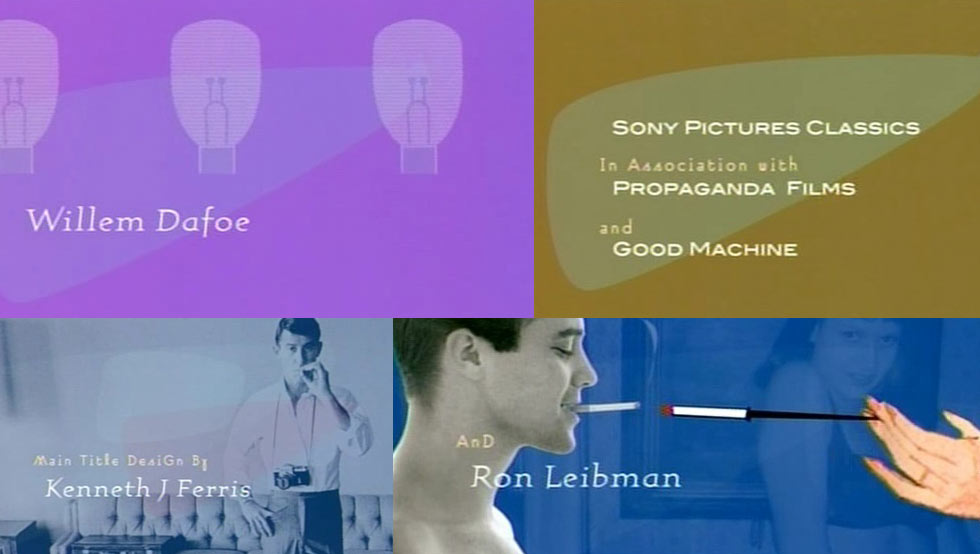
Starring: Greg Kinnear, Willem Dafoe, Rita Wilson, Maria Bello
Director: Paul Schrader
Paul Schrader’s film, Autofocus, is the story of Bob Crane (played by Greg Kinnear), who had the title character in the hit TV series, “Hogan’s Heroes” in the late 1960′s. The interesting thing about the real-life story of Bob Crane is the fact that he was brutally murdered in 1978 by a killer who was never convicted, even though everyone knew who it was. The movie examines how fame and fortune in Hollywood can turn someone’s life upside down – in this case, by over-feeding a man’s sex-obsession to the point of self-destruction.
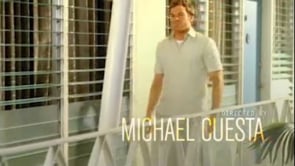
Dexter is an American television drama series based on the novel Darkly Dreaming Dexter by Jeff Lindsay and adapted for television by Emmy Award-winning screenwriter James Manos, Jr., who wrote the pilot episode. Set in Miami, the series centers on Dexter Morgan (Michael C. Hall), a serial killer who works for the Miami Metro Police Department as a blood spatter analyst.
The main creative forces behind the series (showrunners) are executive producers Daniel Cerone and Clyde Phillips; Cerone left the show after its second season. The series premiered on the premium cable network Showtime on October 1, 2006. Dexter has received considerable critical acclaim and has won two Emmys in technical categories, and has also generated public controversies concerning its content and promotion. An edited version of the series began airing on CBS on February 17, 2008 to make up for the shortage of new content caused by the 2007-08 Writers Guild of America strike. Canada’s CTV simulcasts episodes along with CBS, and is also airing the edited version in order to follow Canadian cable simultaneous substitution rules.
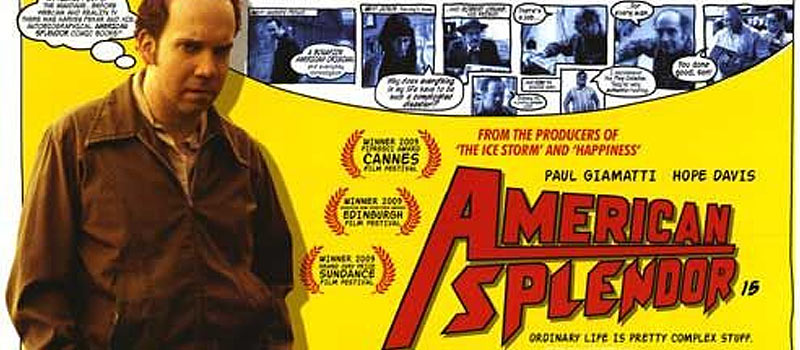
American Splendor is a series of autobiographical comic books and graphic novels written by Harvey Pekar and drawn by a variety of artists. The first issue was published in 1976 and the most recent in September 2008, with publication occurring at irregular intervals. Publishers have been, at various times, Harvey Pekar himself, Dark Horse Comics, and DC Comics